
Can you fall back in love with someone you fell out of love with?
Can you fall back in love with someone? Yes, but it is not guaranteed. Learn how to explore reconnection, respect boundaries, and decide what you want.


Key Takeaways
- Can you fall back in love with someone? Yes, but neither effort nor shared history guarantees renewed feelings.
- Rebuilding love requires mutual willingness, safety, and changes to the patterns that created distance.
- Missing someone does not prove that restarting the relationship is right for you.
- Lovon offers emotional support for self-reflection, not a verdict about whether you should stay or leave.
Yes, you can fall back in love with someone you fell out of love with, but renewed feelings are not guaranteed. Rebuilding a relationship takes more than missing the person: both people need to want it, address what created distance, and respect each other’s boundaries. This 2026 guide helps you decide whether to try reconnecting without pressuring yourself to feel something you do not.
TL;DR
- Can you fall back in love with someone? Yes, but neither effort nor shared history guarantees renewed feelings.
- Rebuilding love requires mutual willingness, safety, and changes to the patterns that created distance.
- Missing someone does not prove that restarting the relationship is right for you.
- Lovon offers emotional support for self-reflection, not a verdict about whether you should stay or leave.
Can you fall back in love with someone you fell out of love with?
Yes. Feelings can change again, just as they changed before. But the useful question is not only whether love can return; it is whether you want a relationship with this person as they are now.
Start by separating these questions:
- What changed? Name the distance, hurt, exhaustion, or difference in priorities rather than treating everything as lost chemistry.
- What is different now? Look for actions you can describe, not promises about becoming a different person.
- Do you both want to explore this? Reconnection needs consent, including permission to decide against continuing.
If you are still together, losing feelings in a long relationship deserves attention without becoming an automatic breakup verdict. You can take uncertainty seriously without making a decision during an argument or demanding an immediate answer from yourself.
The possibility of falling back in love is not an obligation to try. Shared history matters, but it does not cancel your needs or your partner’s right to say no.
Why this matters
When you feel distant, you might blame yourself for not trying hard enough. Or you might assume that a quieter relationship means you chose the wrong person. Neither conclusion follows from uncertainty alone.
Separate what you feel from what you are willing to do. You might feel little romantic excitement yet want to explore repair; you might still feel love and know that the relationship is not right for you.
Whether you are considering reconciliation in 2026 or questioning an ongoing relationship, focus on the conditions you would be returning to. A reunion is not the same thing as a repaired relationship.
What does rebuilding love look like in different situations?
There is no single explanation for falling out of love. Use these situations as reflection prompts, not as a test that tells you what your feelings mean.
| Situation | Best next step | What that step offers | Limitation to recognize |
|---|---|---|---|
| You feel distant but still respect each other | Explore low-pressure reconnection | Space to learn whether you still enjoy closeness | Shared activities do not resolve unspoken hurt |
| You feel hurt by repeated behavior | Address accountability and boundaries | A clear focus on what needs to change | An apology does not establish lasting change |
| You miss an ex after separating | Review the full relationship before contacting them | A decision that includes both affection and difficulties | Missing someone does not establish compatibility |
| You want different futures | Discuss the actual disagreement | Clarity about whether your plans can coexist | Strong feelings do not settle incompatible goals |
| You fear your partner’s reaction | Seek individual safety support | Help centered on your safety and choices | Joint relationship work is not a substitute for safety planning |
Choose the next step for the problem you have, not the reunion you hope for. If the issue is an unequal workload, another romantic evening does not answer who will carry that work tomorrow.
You do not need to label your entire relationship before having a useful conversation. Start with something observable: how disagreements end, whether boundaries are respected, or whether both people follow through.
Why the possibility of falling back in love varies
These factors deserve attention before you decide to try again:
- Mutual willingness. Ask whether each person wants to explore reconnection without guilt, repeated persuasion, or pressure.
- Safety and respect. Notice whether you can disagree, decline affection, or ask for space without threats or punishment.
- The source of distance. An overloaded schedule calls for a different conversation than deception or conflicting plans for children.
- Accountability. Look for acknowledgment of specific behavior and its impact, rather than explanations that erase responsibility.
- Present-day compatibility. Ask whether the relationship fits your current values and needs, not only the life you once planned.
- Your wider emotional health. If enjoyment feels absent throughout your life, discuss that broader change with a licensed professional rather than treating it only as a relationship question.
These are conversation topics, not a formula for predicting love. You can find encouraging changes and still decide not to restart.
How can you explore reconnection without forcing feelings?
Use this 2026 reconnection plan as a way to gather clarity, not as a deadline for falling in love. The aim is to learn whether a different relationship is possible and wanted.
Name the distance
Describe what feels missing in plain language. Is it warmth, trust, attraction, companionship, or the feeling that your needs matter?
Write a few observations before you talk. Describe evenings spent avoiding conversation, a disagreement that never gets resolved, or a need you have stopped mentioning. Specific experiences give you something to discuss without claiming to know your partner’s motives.
Ask for willingness
Invite a conversation about whether you both want to explore repair. Explain what you want to understand, and make room for an answer you do not want.
A reluctant yes is not a reason to push harder. If your partner declines, respect that decision; do not use repeated messages, gifts, jealousy, or guilt to reopen it.
Choose a change
Agree on a concrete behavior related to the distance. That might mean sharing an overlooked responsibility, listening without interrupting, or returning to a difficult discussion after an agreed pause.
Do not make affection the required outcome. You can agree to behave more respectfully, but neither person can promise that romantic feelings will follow.
Notice the response
Pay attention to what happens when the relationship is not in a hopeful moment. Are boundaries still respected during disappointment? Does follow-through continue when it is inconvenient?
Include your own experience. Notice whether you feel interested in knowing your partner again or mainly relieved that a breakup has been postponed.
Review your choice
Choose a time together to discuss what you have noticed. There is no universal deadline for feelings to return, so do not turn this conversation into a pass-or-fail test.
Ask whether the changes are meaningful and whether you both want to continue. You are allowed to stop exploring reconnection even if the other person has made a sincere effort.
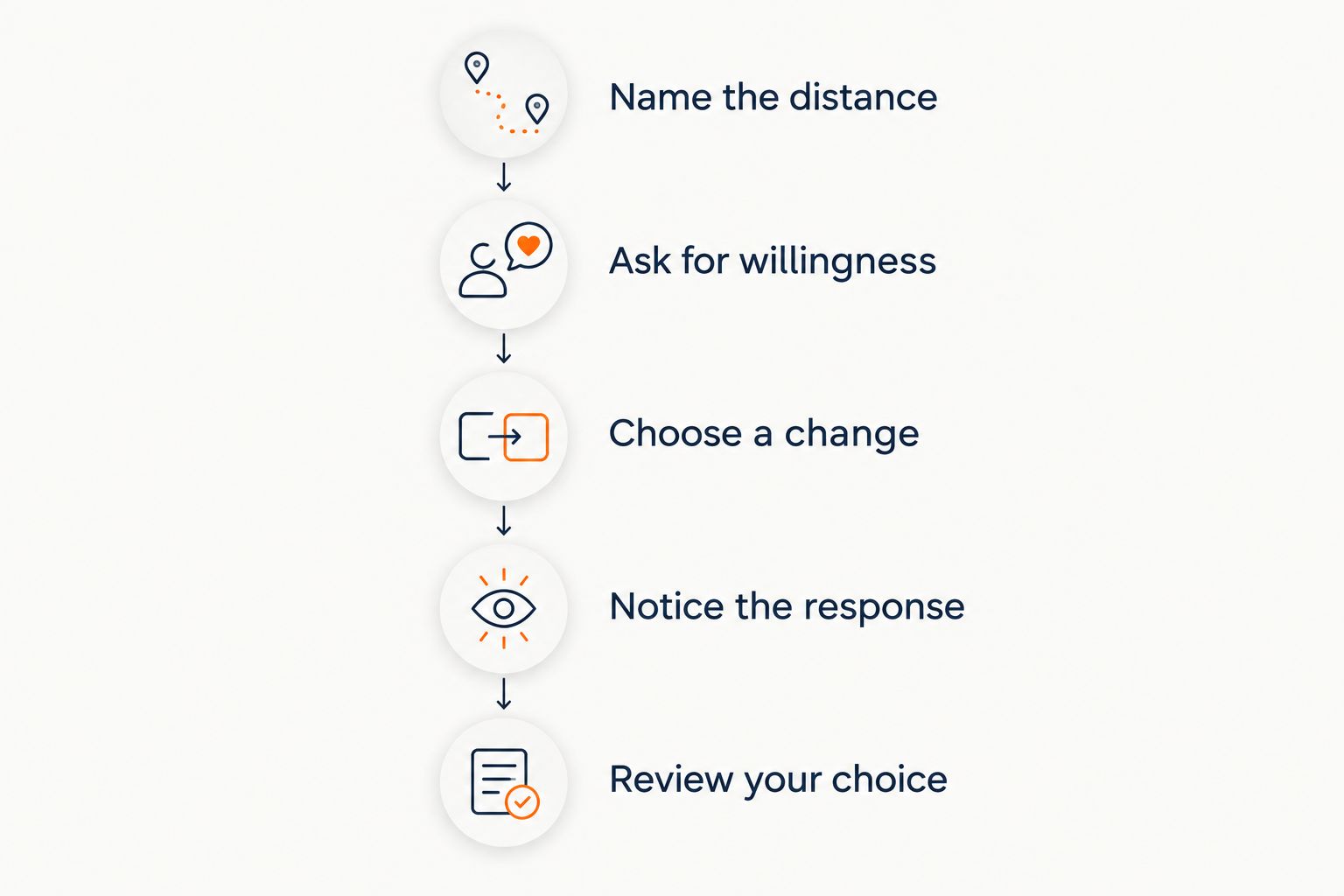 Five steps for exploring relationship reconnection without requiring romantic feelings to return.
Use the process to understand your choices, not to demand a particular feeling.
Can you fall back in love with an ex?
Yes, you can fall back in love with an ex, but renewed attraction does not establish that getting back together is a good decision. Include the reasons you separated when considering what a reunion would involve.
Before contacting an ex in 2026, consider these questions:
- Do you miss the person as they are, or the companionship you once had?
- What has changed about the issue that ended the relationship?
- Has your ex asked for no contact or otherwise made their boundaries clear?
- Would you want this relationship if you were not afraid of being alone?
If contact is welcome, start with a conversation rather than an assumed reunion. Do not treat friendliness, nostalgia, or physical intimacy as an agreement to restart the relationship.
How long does it take to fall back in love?
There is no universal timeline for falling back in love. A fixed deadline cannot tell you whether your feelings are genuine or whether a relationship is healthy.
Instead of checking constantly for a spark, observe the relationship you are experiencing. Can you speak honestly? Do you enjoy time together without feeling responsible for producing romance?
For a relationship decision in 2026, a review point is more useful than a promise to feel differently by a certain date. Agree when to talk again, while keeping either person free to change their mind sooner.
Can you make yourself love someone again?
You cannot guarantee romantic feelings through effort. You can choose honest conversations and considerate behavior, but you do not owe someone attraction because they are kind or trying hard.
Avoid turning every interaction into an examination of your feelings. If repeated checking, reassurance-seeking, or relationship doubts are distressing and difficult to interrupt, speak with a licensed mental health professional rather than diagnosing yourself from online content.
When should you stop trying to reconnect?
Stop treating reconnection as your responsibility when the other person does not want it. A relationship cannot be rebuilt by one person repeatedly persuading the other to participate.
Also take repeated boundary violations seriously. You do not have to keep offering chances because someone apologizes, because you have children together, or because ending the relationship would disappoint other people.
If there are threats, sexual coercion, stalking, violence, or controlling behavior, prioritize individual support and safety planning. Do not use this reconnection exercise as a reason to confront someone who could put you in danger. A domestic violence advocate can help you consider safer options; contact emergency services if you are in immediate danger.
You do not need proof that a relationship is beyond repair before choosing to leave. Not wanting to continue is a decision you are allowed to make.
Where can you get support while sorting out your feelings?
Lovon is best for people who want voice-based emotional support while reflecting on relationship uncertainty. You can use Lovon for conversations, coping tools, and self-reflection guidance when you want to talk through what you are experiencing.
The benefit of Lovon’s mental health support is having a place to put feelings into words. The limitation is equally important: Lovon is not a licensed clinician, cannot know your partner’s perspective, and does not replace clinical care or emergency support.
A licensed therapist is the appropriate choice for assessment or treatment of persistent distress. Couples counseling offers a setting for discussing relationship patterns when both people freely agree and it is safe to participate; it cannot promise reconciliation.
One last thing
Before asking whether you can recover the old relationship, ask what you would choose to build now. Name the respect, closeness, boundaries, and shared responsibilities you would need.
You do not have to recreate the beginning to make a thoughtful decision. Reconnection is worth exploring only when both people can freely choose the relationship that exists today.
Related guides
How AI Support Helps You Heal
AI emotional support isn't about replacing human connection — it's about filling the gaps. The moments when you need to talk at 2 AM, when you don't want to burden your friends again, or when you simply need someone to listen without judgment.
Here's what happens in a typical Lovon session:
You share what's on your mind
There's no script, no intake form, no waiting room. You speak or type whatever you're feeling — in your own words, at your own pace.
Lovon validates and explores
Using frameworks from CBT (Cognitive Behavioral Therapy) and motivational interviewing, Lovon acknowledges your feelings first, then gently helps you explore them. No dismissive "just move on" advice.
You build coping skills together
Lovon doesn't just listen — it actively works with you on evidence-based techniques: thought reframing, urge surfing, behavioral experiments, and more.
What a Session with Lovon Looks Like

Lovon is AI support, not a replacement for professional care. If things have been hard to get through for weeks, or you are thinking about harming yourself, talk to a doctor or a licensed therapist.
Ready to Start?
Your healing journey can begin right now
A 3-day trial. No judgment. Just a safe space to process what you're going through.
Frequently Asked Questions
Can you fall back in love with someone after losing feelings?
Does missing my ex mean I should get back together?
How do I know whether I want my partner or just do not want to be alone?
Can love return if only one person is trying?
Should we try physical intimacy to bring feelings back?
How long should I wait for feelings to return?
Should I try couples counseling if my partner scares me?
About the Author

The Lovon Editorial Team
Mental Health & Wellness Content Team
The Lovon Editorial Team develops mental health and wellness content designed to make psychological concepts accessible and actionable. Our goal is to bridge the gap between clinical research and everyday life - helping you understand why your mind works the way it does and what you can do about it....
Related articles
- Best AI couples therapy apps in 2026
Compare the best AI couples therapy apps in 2026. Choose voice support for solo reflection, and licensed couples therapy…
- Am I in Love Quiz: Real Feelings vs Attraction 2026
Take the am I in love quiz and score 5 psychological dimensions to tell real love from attraction. Clear results, no…
- Love Language Compatibility Quiz for Couples 2026
The best love language compatibility quiz in 2026 maps both partners' scores side-by-side, flags mismatches, and…
- Feedback vs Criticism in Relationships: Healthy Intimacy or Harsh Judgment
Every intimate relationship encounters moments where partners need to address concerns, express disappointment, or…
See also
Quizzes
- Love Test: How Strong Is Your Love, and What Kind?
See how strong your love is, and what kind, in 3 minutes.
- Respect in Love Test: Do You Respect Them, and Yourself?
See the respect you give and keep in love, in 3 minutes.
Free tools
- Deep Conversation Starters That Fit the Person You're Asking
The right question depends on who is across from you and how much history is behind it. Tell it who you are talking to…
- I Miss You Texts That Don't Sound Copied
I miss you texts written from what you actually miss. Tell it who you miss and why you are apart: distance, a busy…
From the wiki
- What does falling in love feel like?
Falling in love usually arrives in the body first: a restless stomach, thin sleep, a pulse that reacts to a name on your…
Disclaimer: This article is for informational purposes only and does not constitute medical advice, diagnosis, or treatment. Always seek the advice of your physician or other qualified health provider with any questions you may have regarding a medical condition. If you are in crisis or think you may have an emergency, call 988 (Suicide & Crisis Lifeline) or go to the nearest emergency room. Outside the US? Find a crisis line in your country.