
How long should you wait before moving in together?
How long before moving in together? Choose readiness over a deadline. Discuss money, chores, boundaries, and safety before you commit to sharing a home.


Key Takeaways
- How long before moving in together? Wait for shared readiness, clear agreements, and freedom to say no.
- Discuss money, chores, privacy, conflict, and future expectations before choosing a move-in date.
- Lovon offers emotional support for relationship worries, not a clinical assessment of whether you should move in.
- Pause if moving in means accepting pressure, control, or unresolved safety concerns.
Wait until you both freely want to share a home, understand each other’s everyday habits, and have agreed on money, chores, boundaries, and what happens if living together does not work. Use readiness—not a set number of months—as your decision rule. A lease deadline or a chance to split expenses is a practical concern, not proof that your relationship is ready.
TL;DR
- How long before moving in together? Wait for shared readiness, clear agreements, and freedom to say no.
- Discuss money, chores, privacy, conflict, and future expectations before choosing a move-in date.
- Lovon offers emotional support for relationship worries, not a clinical assessment of whether you should move in.
- Pause if moving in means accepting pressure, control, or unresolved safety concerns.
Why this matters
Moving in together changes more than where you sleep. You start sharing ordinary decisions: whose workday needs quiet, who notices the groceries are running low, and how much time you spend alone.
You do not need perfect compatibility. You need room to disagree without losing your voice. If you are unsure whether closeness has become dependence, this guide to codependency vs. love offers a useful starting point for reflection.
If you are planning a move in 2026, start with the relationship you have now—not the relationship you hope a shared address will create.
How long should you wait before moving in together?
Wait until you can make an informed, unpressured choice about sharing daily life. Time together gives you opportunities to learn about each other, but an anniversary does not answer questions about household responsibilities or emotional safety.
Use this comparison to choose your next step. These are decision prompts, not a test that predicts whether your relationship will last.
| Choice | Best for | What it offers | Main limitation |
|---|---|---|---|
| Move forward with planning | Couples who both want it and have clear household agreements | A deliberate transition into a shared home | Agreements still need adjustment once you live together |
| Stay separate while preparing | Couples with unanswered practical questions | Space to discuss expectations without changing housing | Requires patience and another conversation about timing |
| Pause the move | Anyone facing pressure, fear, or controlling behavior | Time to seek support and consider safety | Does not resolve the underlying relationship problem |
Ask yourselves what you know from experience. Have you handled changed plans, tired evenings, illness, disappointment, and disagreements together? Can you name a problem you worked through rather than simply waited out?
You do not need to manufacture stressful situations to find out. Pay attention to ordinary life, and discuss the parts you have not yet experienced together.
What should you agree on before moving in together?
Before you book movers or give notice, work through these steps together. Write down the agreements in plain language so neither person has to rely on memory.
Name the purpose
Explain why you want to live together. Separate wanting more shared life from wanting relief from loneliness, a difficult roommate, or housing pressure.
Discuss what the move means for commitment. If one person sees it as a step toward marriage and the other sees it as a convenient arrangement, make that difference explicit before signing anything.
Share the finances
Discuss income stability, existing obligations, household bills, and how you will handle an unexpected expense. Decide what stays separate and what you will share.
Avoid treating equal contributions as an automatic answer. Agree on an arrangement both people understand and can accept without pressure, then discuss how to revisit it if circumstances change.
Divide the work
List the recurring tasks, including the work of noticing and planning. Cooking dinner and remembering that dinner needs ingredients are different responsibilities.
Give tasks clear ownership rather than relying on someone to ask for help. Discuss what happens during busy periods, illness, or exhaustion without assuming one partner will absorb everything.
Protect personal space
Talk about sleep, visitors, remote work, belongings, affection, and time alone. Sharing a home does not mean sharing every password, conversation, or free evening.
Make your boundaries specific enough to use. Explain whether you need quiet after work or notice before overnight guests, rather than expecting your partner to infer what respect means to you.
Plan for change
Read the housing agreement and understand your obligations before committing. Discuss belongings, pets, shared purchases, and where each person would stay if the arrangement ended.
An exit conversation is not a prediction of failure. It is a way to make sure neither person has to remain in an unsuitable home because practical questions were left unanswered.
For a 2026 move, put these agreements in the same planning document as your packing list. The conversations belong before the move, not after the first household argument.
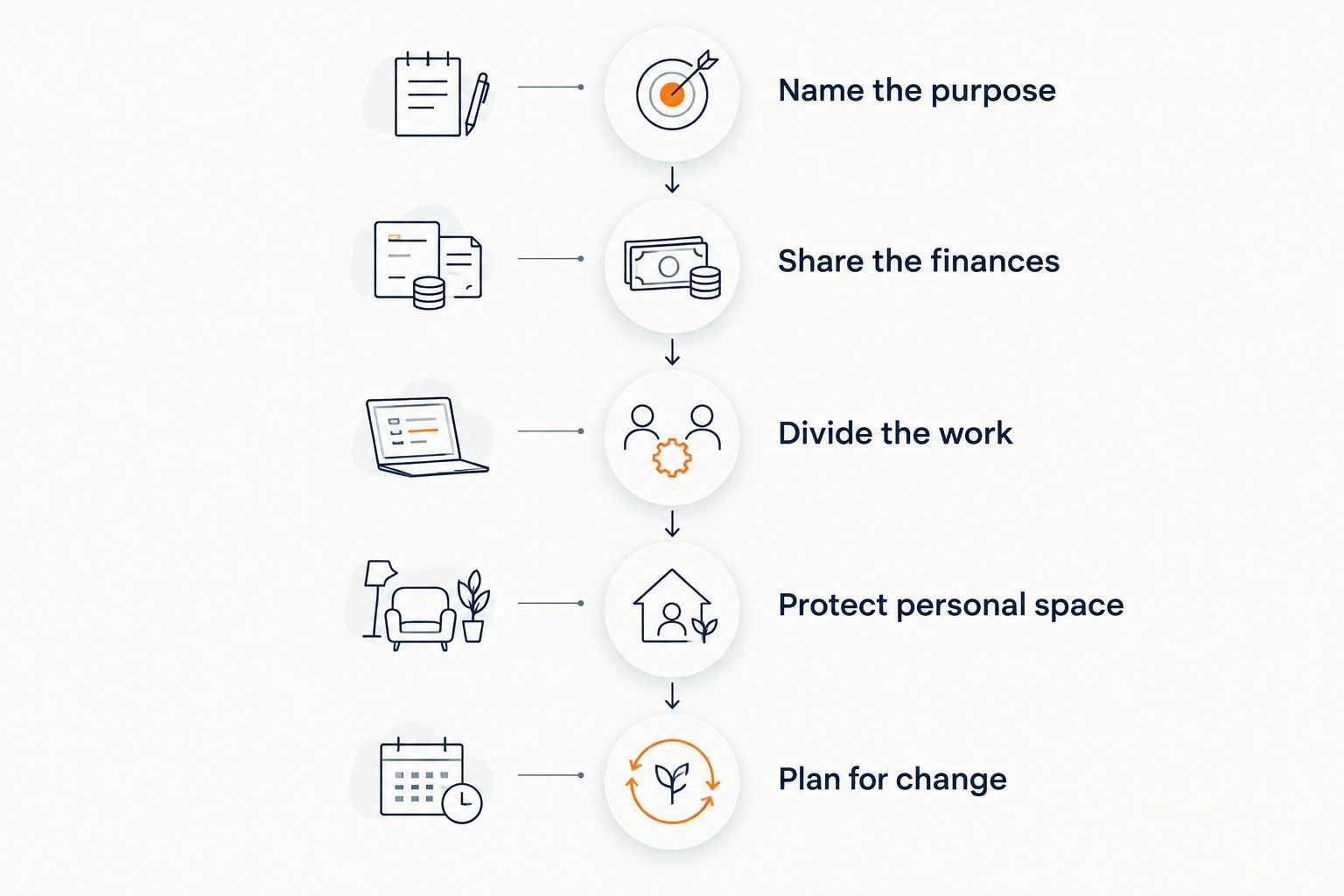 Five conversations to have before sharing a home, from naming the purpose to planning for change.
Discuss the relationship and the household before choosing your move-in date.
Why the right timing varies
Your calendar matters less than what you have had the chance to learn and discuss. Use these factors to identify the questions that still need an answer:
- Everyday experience: Consider whether your time together includes ordinary routines or mostly dates, vacations, and carefully planned visits.
- Conflict repair: Look for respectful follow-through after disagreements, not just an apology that ends an uncomfortable conversation.
- Financial clarity: Make sure both people understand their responsibilities and can raise concerns about the arrangement.
- Household expectations: Discuss cleanliness, sleep, guests, pets, work schedules, and private space rather than assuming they match.
- Shared meaning: Clarify whether cohabitation means the same thing to each of you, including expectations about commitment.
- Freedom to choose: Check whether both people can ask for more time without threats, punishment, or guilt.
A clear answer does not have to be an enthusiastic yes today. Identifying what you still need to discuss gives you something more useful than comparing your timeline with another couple’s.
What if you have mostly dated long-distance?
For a long-distance couple, separate the wish to close the distance from the choice to share a home. They are related decisions, but they are not identical.
Visits give you information about being together. Also discuss what a normal workday would look like, how you would maintain friendships, and what support the relocating partner would have outside the relationship.
If you are choosing between relocating together and living separately nearby, compare the practical demands of each rather than treating one as proof of commitment:
| Arrangement | Best for | Practical benefit | Trade-off |
|---|---|---|---|
| Separate homes nearby | Couples who want everyday experience before sharing housing | Keeps household decisions separate while you learn local routines | Requires separate housing arrangements |
| A shared home | Couples who have chosen cohabitation as well as relocation | Combines the move with the household you both want | Adds shared-home decisions to the relocation |
Neither choice proves how much you love each other. Choose the arrangement you can both discuss honestly and manage in practice.
What if moving in would solve a housing problem?
Housing pressure deserves a practical answer, not shame. You can acknowledge that sharing expenses or leaving an unsuitable home matters without calling those circumstances evidence of relationship readiness.
For a move planned in 2026, separate your housing deadline from your relationship decision. Write down which arrangements are necessary, which are optional, and what alternatives you can realistically investigate.
If moving in remains your choice, keep the reasons visible. Agree on responsibilities, privacy, and an exit plan without promising a level of commitment you do not feel.
What if one partner wants more time?
Treat “not yet” as a request to understand, not an obstacle to overcome. Ask what feels unfinished: the relationship itself, the household plan, the location, or the timing.
Try a direct question: what would you need to know or agree on before revisiting this? Then decide together when to talk again, without turning that conversation into a deadline for saying yes.
The partner who wants to move is allowed to feel disappointed. The partner who wants to wait is still allowed to decline. Neither person has to disguise their needs to keep the discussion comfortable.
When should you pause the move entirely?
Pause if you feel afraid to disagree, are being pushed to give up access to money, or are expected to accept monitoring and isolation as conditions of living together. Do not treat intimidation or threats as ordinary moving stress.
You do not need to sign a lease to prove trust. You also do not need to explain away a boundary because the other person has already made plans.
If you are worried about your safety, seek individual support from a qualified professional or a domestic violence service before discussing a joint plan. If danger is immediate, contact emergency services. A household checklist is not a substitute for safety support.
How can you sort through your feelings before the conversation?
Separate what you want from what you fear. Write or say what appeals to you about sharing a home, what feels uncertain, and what information would help you decide.
Lovon is best for people who want voice-based emotional support while reflecting on everyday relationship worries. The Lovon mental health app offers coping tools and self-reflection guidance; it is not a licensed clinician and cannot decide whether a relationship is safe or ready for cohabitation.
If talking aloud helps you prepare, Lovon is an option for individual reflection—not a replacement for the conversation with your partner or licensed clinical care. Take any useful insight back to a specific request, boundary, or question.
One last thing
Before your 2026 move, practice changing your mind about a small household decision. Suggest a different guest arrangement, chore division, or furniture choice and notice whether both people have room to respond.
Do not use the conversation as a secret test. Use it to practice the skill you will need in a shared home: making a request, hearing a different preference, and finding an agreement without erasing either person.
Your move-in date should follow a shared decision—not make that decision for you.
Related guides
How AI Support Helps You Heal
AI emotional support isn't about replacing human connection — it's about filling the gaps. The moments when you need to talk at 2 AM, when you don't want to burden your friends again, or when you simply need someone to listen without judgment.
Here's what happens in a typical Lovon session:
You share what's on your mind
There's no script, no intake form, no waiting room. You speak or type whatever you're feeling — in your own words, at your own pace.
Lovon validates and explores
Using frameworks from CBT (Cognitive Behavioral Therapy) and motivational interviewing, Lovon acknowledges your feelings first, then gently helps you explore them. No dismissive "just move on" advice.
You build coping skills together
Lovon doesn't just listen — it actively works with you on evidence-based techniques: thought reframing, urge surfing, behavioral experiments, and more.
What a Session with Lovon Looks Like

Lovon is AI support, not a replacement for professional care. If things have been hard to get through for weeks, or you are thinking about harming yourself, talk to a doctor or a licensed therapist.
Ready to Start?
Your healing journey can begin right now
A 3-day trial. No judgment. Just a safe space to process what you're going through.
Frequently Asked Questions
How long before moving in together should we wait?
Is moving in together early always a mistake?
Should we move in together to save on household expenses?
Does moving in together mean we are getting married?
What if I love my partner but do not want to live together yet?
What should we discuss before signing a lease together in 2026?
Can Lovon tell me whether I should move in with my partner?
About the Author

The Lovon Editorial Team
Mental Health & Wellness Content Team
The Lovon Editorial Team develops mental health and wellness content designed to make psychological concepts accessible and actionable. Our goal is to bridge the gap between clinical research and everyday life - helping you understand why your mind works the way it does and what you can do about it....
Related articles
- How to Set Boundaries With a Narcissist (2026 Guide)
Learn how to set boundaries with a narcissist without conflict: scripted language, the gray rock method, and…
- Emotionally Immature Parents Boundaries That Hold in 2026
Set boundaries with emotionally immature parents in 2026 using scripted limits, exit lines, and follow-through steps…
- People Pleasing Trauma Response: How to Stop It in 2026
People pleasing trauma response explained: it's the fawn response, not weakness. Six steps to stop it in 2026, plus what…
- Is it normal to still think about your ex years later?
Thinking about ex years later can be normal. Learn how to distinguish passing memories from rumination, set boundaries…
See also
Quizzes
- Boundaries Test: Do I Have Healthy Boundaries? Free Quiz
See where your boundaries slip, in 3 minutes.
- Am I Codependent? 12-Question Self-Check
See how much of you is left over, in 2 minutes.
Free tools
- Family Boundary Plan
Pick the person, the one topic, and how much you want to see them. You get a three-rung ladder, the guilt lines to…
- Feelings Wheel
Tap the broad feeling in the middle and the wheel zooms in until you reach the word that fits. Each word opens a short…
From the wiki
- Why do I feel sad when I'm alone?
Being alone does not create the sadness. It removes the noise that was keeping it out of earshot, so whatever queued up…
Disclaimer: This article is for informational purposes only and does not constitute medical advice, diagnosis, or treatment. Always seek the advice of your physician or other qualified health provider with any questions you may have regarding a medical condition. If you are in crisis or think you may have an emergency, call 988 (Suicide & Crisis Lifeline) or go to the nearest emergency room. Outside the US? Find a crisis line in your country.