
Is it normal to dread social plans even with people you love?
Dreading social plans with people you love can be normal. Learn to separate anxiety from exhaustion, adjust plans, and recognize when to seek support.


Key Takeaways
- Dreading social plans with people you love does not, by itself, mean you love them less.
- Anticipatory anxiety, exhaustion, and uncomfortable expectations call for different responses.
- Try a smaller, clearer plan before treating every invitation as an all-or-nothing decision.
- Lovon offers voice-based emotional support, not diagnosis or a replacement for licensed mental health care.
Yes, dreading social plans with people you love can be a normal response to stress, tiredness, or worry about the gathering—not a sign that you care less. But dread that repeatedly keeps you from relationships you want, or comes with persistent low mood or intense fear, deserves attention. Start by separating how you feel about the person from what feels difficult about the plan.
TL;DR
- Dreading social plans with people you love does not, by itself, mean you love them less.
- Anticipatory anxiety, exhaustion, and uncomfortable expectations call for different responses.
- Try a smaller, clearer plan before treating every invitation as an all-or-nothing decision.
- Lovon offers voice-based emotional support, not diagnosis or a replacement for licensed mental health care.
Is it normal to dread social plans even with people you love?
Yes. You can want closeness and still dislike the effort, uncertainty, or pressure surrounding a visit. Feeling reluctant before an event is different from feeling disconnected from the person.
The useful question is not whether you should feel excited. It is what you are dreading. If your thoughts jump from an invitation to imagined embarrassment or disappointment, learning to stop anxiety spirals before they take over addresses that worry without making the relationship itself the problem.
Use these questions to identify the sticking point:
- Separate person from plan. Would you want to see this person somewhere quieter, earlier, or without a group?
- Name the prediction. Are you expecting awkwardness, conflict, exhaustion, or pressure to seem cheerful?
- Compare before and after. Do you usually settle in once you arrive, or leave feeling worse?
- Check the wider pattern. Is this happening with one relationship, every invitation, or activities beyond socializing?
These questions do not diagnose anything. They help you choose a response that fits instead of automatically forcing yourself to go or canceling.
Why this matters
Your social calendar in 2026 does not need to become a test of how much you love people. Affection and capacity are different: you can care deeply and still need rest, predictability, or a boundary.
At the same time, calling every withdrawal self-care can hide a pattern you want help changing. Anxiety-driven avoidance can bring immediate relief while making future invitations harder to face. The goal is neither constant attendance nor complete retreat; it is keeping meaningful connection possible without ignoring your limits.
Why dread before social plans varies
Different difficulties can produce the same urge to stay home. These are possibilities to explore, not conclusions about your mental health:
- Low energy. A gathering can feel demanding when work, caregiving, poor sleep, or other responsibilities have already used your attention.
- Fear of judgment. You might worry about being boring, looking anxious, or saying something wrong—even around familiar people.
- Sensory demands. Noise, crowded spaces, strong smells, or overlapping conversations can make the setting difficult regardless of the company.
- Pressure to perform. Being the entertainer, organizer, peacemaker, or constant listener can turn connection into another responsibility.
- Relationship tension. Unresolved conflict, criticism, or intrusive questions can give you a specific reason to feel uneasy.
- Broader distress. Anxiety and depression can affect social participation. Dread alone does not establish either condition.
Look for what changes the feeling. If a quiet visit sounds welcome but a loud dinner feels unbearable, the setting deserves attention before you question your affection.
Should I go, change the plan, or stay home?
Choose based on the obstacle, not on guilt alone. None of these options is always right, and each has a trade-off.
| Response | Best for | What it offers | What to watch for |
|---|---|---|---|
| Keep the plan | Manageable nerves around people you feel safe with | A chance to connect despite initial discomfort | Pushing through genuine exhaustion or unsafe behavior |
| Change the plan | A difficult setting, timing, or unclear expectations | Connection with fewer demands | Reshaping every plan solely to avoid any anxiety |
| Decline and reconnect | Illness, depleted capacity, or a needed boundary | Rest and room to make a deliberate choice | Repeated cancellation that leaves you isolated |
Ask yourself whether you want the connection if the difficult part changes. A smaller visit is not a lesser friendship. Equally, you do not need to negotiate yourself into attending something that feels unsafe.
When keeping the plan makes sense
If you usually enjoy yourself once you arrive, and the people treat you well, consider attending without requiring yourself to feel excited first. Decide what participation looks like before you leave home.
You can listen more than you speak or leave at the agreed time. Showing up does not require being the most energetic person there.
When changing the plan makes sense
Change the part you can name: the location, group size, timing, activity, or length. A walk with a close friend asks something different of you than an open-ended evening in a crowded restaurant.
Keep the change specific. A clear request is easier to respond to than a vague promise to meet when life feels calmer.
When declining makes sense
Rest is a legitimate need, and so is distance from someone who mistreats you. Decline directly rather than building an elaborate excuse.
If you want to preserve the connection, offer another form of contact you can genuinely manage. Do not promise a replacement plan just to reduce guilt.
How can I make the next plan feel more manageable?
For your next gathering in 2026, treat the plan as something you can adjust—not a verdict on your character. Start with the smallest change that addresses the actual difficulty.
Name the obstacle
Finish this sentence privately: The part I am dreading is… Be concrete. Getting ready, traveling, answering personal questions, and staying late are different problems.
If everything feels tangled, write down the first moment you imagine wanting to escape. That moment gives you a starting point.
Adjust the plan
Choose a change that answers the obstacle. Ask for a quieter location, a defined ending, or a visit without additional guests.
You do not need to eliminate every uncomfortable feeling before attending. Aim for a plan you can reasonably participate in, not a guarantee of perfect comfort.
Say the boundary
Tell the other person what you can do before the event. For example, you might explain that you want to see them but need a quiet evening and will leave after dinner.
Keep your message about your needs rather than guessing their reaction. A boundary is clearer when it describes your action instead of asking someone to approve your feelings.
Review afterward
Notice what actually happened rather than grading your performance. Did the worry settle, did the setting remain difficult, or did someone disregard your limit?
Look at your actual 2026 calendar when reflecting. Which invitations were manageable, and what did they have in common? Your own observations are more useful than a rule that you must always go or always rest.
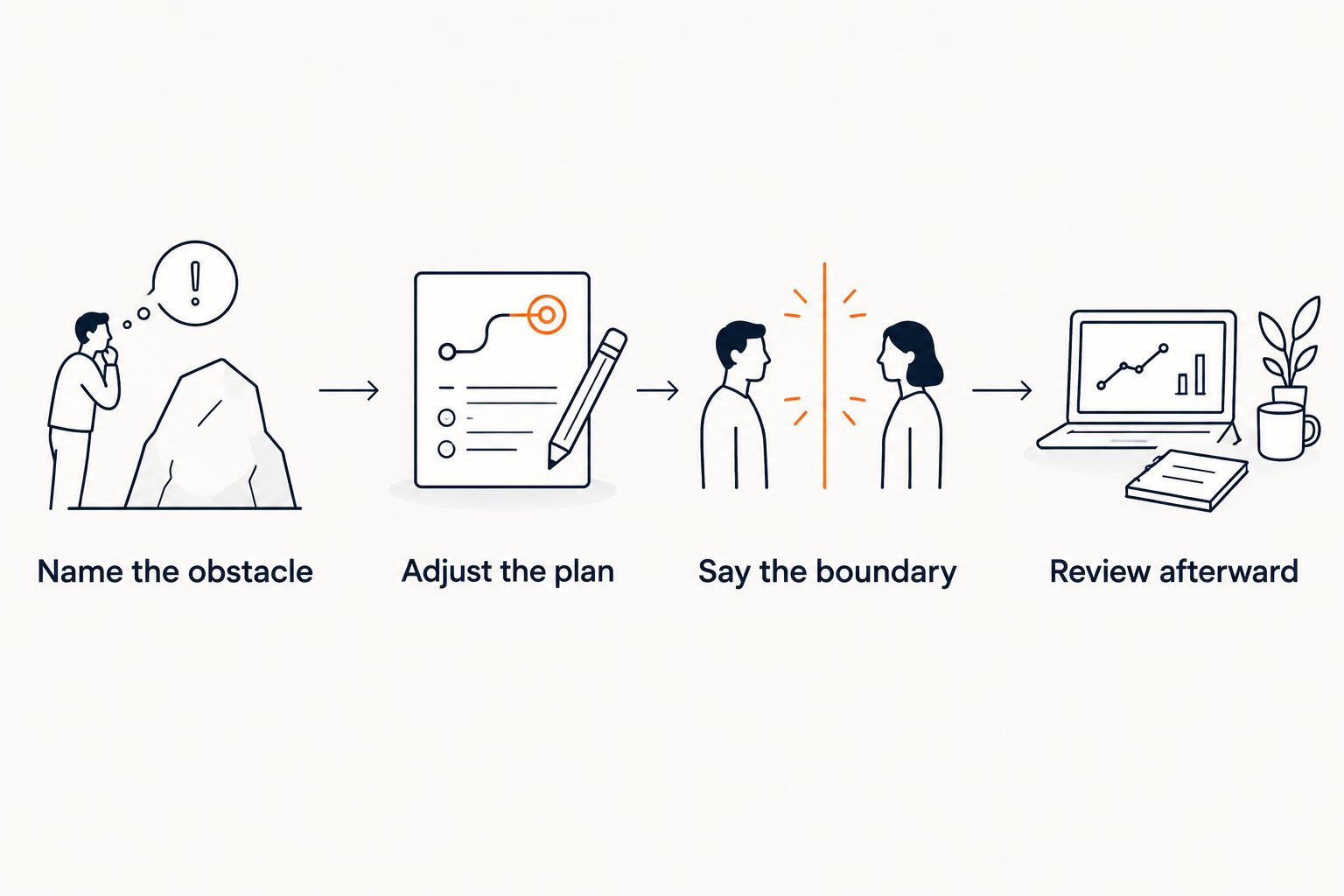 Four steps for identifying social dread, adjusting a plan, communicating a boundary, and reflecting afterward.
Change the part of the plan that creates difficulty, then notice whether the change helped.
What if noise, masking, or social effort is the difficult part?
Sometimes the issue is not fear of people. It is the effort of filtering noise, following several conversations, or monitoring your expressions and responses. You can enjoy someone and still find their preferred gathering exhausting.
Consider whether a quieter setting lets you participate more comfortably. Ask about the location and who will attend before committing. You can also explain that stepping outside or leaving early is about your capacity, not rejection.
For autistic people, persistent exhaustion and reduced ability to manage everyday demands deserve more attention than an instruction to socialize harder. A conversation about therapy for autistic burnout should address sensory demands, masking, and sustainable support rather than treating increased social attendance as the sole goal.
Dreading plans does not establish that you are autistic or experiencing burnout. If these difficulties are persistent or unfamiliar, a qualified professional can help you understand the broader pattern.
How do I tell someone I love that I am dreading our plans?
Describe the difficulty without making the person responsible for fixing your mood. You can be honest about limited energy while still expressing care.
A message can include warmth, a limit, and a realistic alternative. For example: I want to spend time with you, but a group dinner feels like too much right now. Would you be open to a quiet walk instead?
If the relationship itself is the issue, changing venues will not resolve it. Name the behavior: personal questions you do not want to answer, jokes at your expense, or pressure to stay after you have said you need to leave.
Someone can feel disappointed without your boundary being wrong. But repeated intimidation, punishment, or disregard for your limits calls for support and attention to your safety—not more practice tolerating the gathering.
Does feeling relieved when plans are canceled mean I do not love them?
Relief when plans are canceled does not, by itself, mean you do not love the person. It tells you that an anticipated demand has disappeared; it does not tell you which demand was difficult.
Ask what the relief is about. Is it avoiding travel, getting needed rest, escaping judgment, or not having to interact with this particular person? The answer helps distinguish a capacity issue from a relationship concern.
Why do I dread going but enjoy myself once I arrive?
Enjoying yourself after arriving can mean the anticipation is harder than the gathering. Beforehand, uncertainty leaves room for predictions that do not match the actual experience.
Use that pattern as evidence, not a command to ignore all discomfort. A manageable visit with safe people is different from repeatedly enduring exhaustion or mistreatment.
When should I seek support for dreading social plans?
Seek support when dread repeatedly blocks relationships you want, disrupts daily life, or appears alongside persistent low mood, panic, or loss of interest. You do not have to wait until you stop seeing everyone.
A licensed mental health professional can assess the wider pattern and discuss appropriate care. New or persistent exhaustion also deserves medical attention rather than an assumption that it is only psychological.
When choosing support in 2026, distinguish a reflection tool from clinical care. Lovon is best suited to people seeking voice-based emotional support and self-reflection, not clinical assessment. The Lovon mental health app offers conversations and coping tools, but it is not a licensed clinician and cannot replace treatment.
If speaking aloud helps you organize what feels difficult, Lovon is an option for that reflection. Its limitation matters: an app conversation cannot determine whether social dread reflects anxiety, depression, burnout, a relationship problem, or another concern.
One last thing
The part you dread might happen before the visit even starts: choosing clothes, arranging transportation, or imagining questions you do not want to answer. Changing that part can be more useful than asking yourself to become more social.
For the rest of 2026, try replacing the question Do I love them enough to go? with What would make this connection manageable? You can care about someone without accepting every version of a plan.
Related guides
How AI Support Helps You Heal
AI emotional support isn't about replacing human connection — it's about filling the gaps. The moments when you need to talk at 2 AM, when you don't want to burden your friends again, or when you simply need someone to listen without judgment.
Here's what happens in a typical Lovon session:
You share what's on your mind
There's no script, no intake form, no waiting room. You speak or type whatever you're feeling — in your own words, at your own pace.
Lovon validates and explores
Using frameworks from CBT (Cognitive Behavioral Therapy) and motivational interviewing, Lovon acknowledges your feelings first, then gently helps you explore them. No dismissive "just move on" advice.
You build coping skills together
Lovon doesn't just listen — it actively works with you on evidence-based techniques: thought reframing, urge surfing, behavioral experiments, and more.
What a Session with Lovon Looks Like

Lovon is AI support, not a replacement for professional care. If things have been hard to get through for weeks, or you are thinking about harming yourself, talk to a doctor or a licensed therapist.
Ready to Start?
Your healing journey can begin right now
A 3-day trial. No judgment. Just a safe space to process what you're going through.
Frequently Asked Questions
Is dreading social plans with people you love normal?
Does wanting to stay home mean I am a bad friend?
Should I force myself to socialize when I feel anxious?
How do I know whether I need rest or am avoiding anxiety?
Is canceling plans always bad for anxiety?
Can a mental health app tell me why I dread seeing friends?
What should I do if social withdrawal comes with thoughts of suicide?
About the Author

The Lovon Editorial Team
Mental Health & Wellness Content Team
The Lovon Editorial Team develops mental health and wellness content designed to make psychological concepts accessible and actionable. Our goal is to bridge the gap between clinical research and everyday life - helping you understand why your mind works the way it does and what you can do about it....
Related articles
- Can social anxiety be cured completely?
Can social anxiety be cured? Lasting improvement is possible, but no treatment promises permanent relief. Learn what…
- Can lack of social interaction cause depression?
Can isolation cause depression? Yes, it can contribute. Learn how isolation and low mood connect, which signs need care…
- Can journaling really reduce stress?
Can journaling really reduce stress? Yes, it can help, but not everyone benefits. Learn what research shows, which…
- Is it normal to feel embarrassed talking to an AI?
Is it normal to feel embarrassed talking to an AI? Yes. Learn why speaking can feel awkward, how to start with a small…
See also
Quizzes
- Introvert or Extrovert? Quiz (and Ambivert)
Introvert, ambivert or extrovert? Find out in 3 minutes.
- Loneliness Test: How Lonely Am I? 3 Kinds of Loneliness
See which kind of loneliness is thin, in 3 minutes.
Free tools
- AI Life Coach
This is a free AI life coach you can use right on this page. Tell it where you feel stuck or what you are deciding, and…
- Self-Love Meditation
Not loving every part of yourself at once, just being a little kinder than usual. Six minutes to notice how you talk to…
From the wiki
- Why do I keep dreaming about my ex?
Recurring dreams about an ex usually mean your brain is still consolidating a relationship that took up years of memory…
Disclaimer: This article is for informational purposes only and does not constitute medical advice, diagnosis, or treatment. Always seek the advice of your physician or other qualified health provider with any questions you may have regarding a medical condition. If you are in crisis or think you may have an emergency, call 988 (Suicide & Crisis Lifeline) or go to the nearest emergency room. Outside the US? Find a crisis line in your country.