
Can you get addicted to using an AI therapy app?
Can you get addicted to an AI therapy app? There's no formal diagnosis in 2026. Learn when daily use turns into over-reliance and how to stay connected.

Key Takeaways
- Can you get addicted to an AI therapy app? There is no distinct clinical diagnosis, but over-reliance can cause
- Daily use alone is not the warning sign; replacing human support and avoiding difficult conversations are.
- Lovon is best used as an AI mental health app for on-demand support, not as a replacement for licensed care.
- If you feel unable to cope without the app, bring that pattern to a licensed mental health professional.
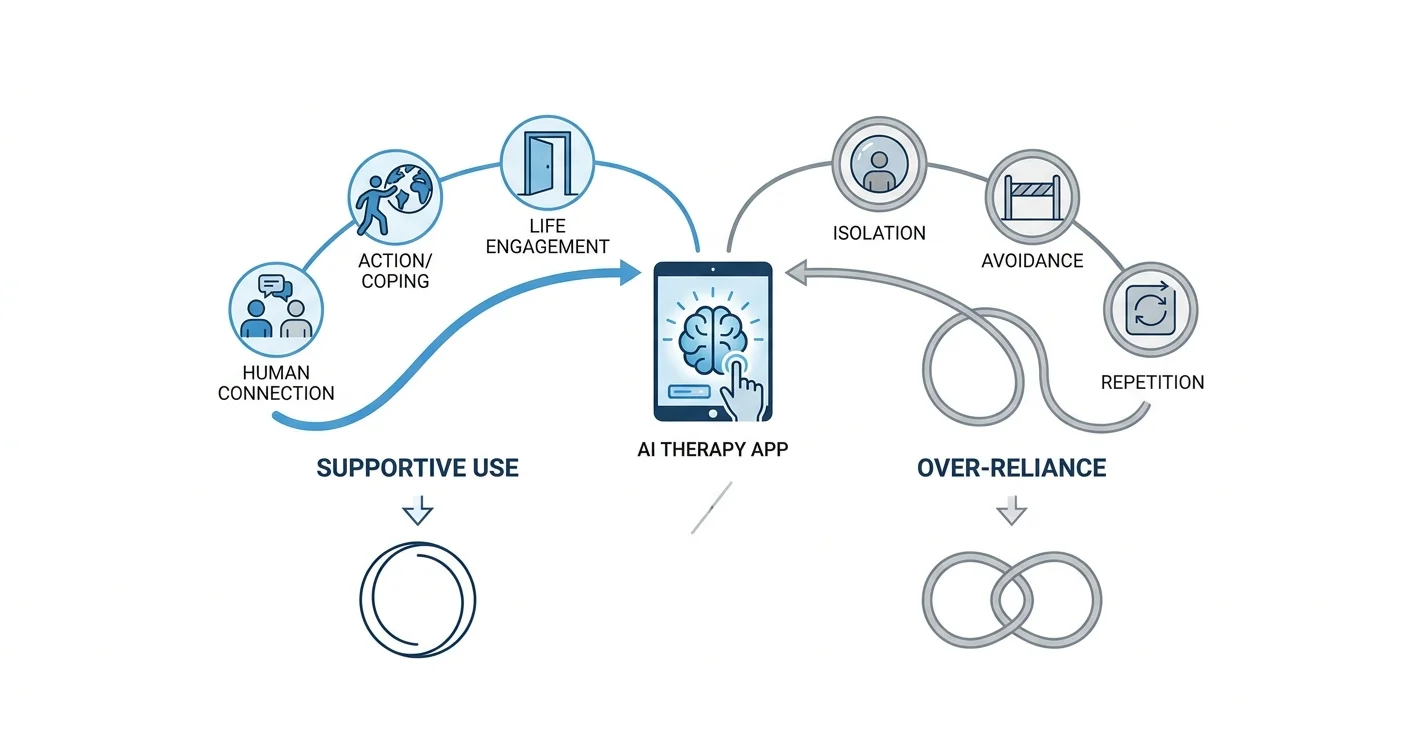
Yes, you can become overly reliant on an AI therapy app, but using one often does not by itself mean you have an addiction. In 2026, AI therapy app addiction is not a distinct clinical diagnosis. The question is whether the app helps you cope and connect with people, or has become a way to avoid both.
TL;DR
- Can you get addicted to an AI therapy app? There is no distinct clinical diagnosis, but over-reliance can cause problems.
- Daily use alone is not the warning sign; replacing human support and avoiding difficult conversations are.
- Lovon is best used as an AI mental health app for on-demand support, not as a replacement for licensed care.
- If you feel unable to cope without the app, bring that pattern to a licensed mental health professional.
Can you get addicted to using an AI therapy app in 2026?
An AI therapy app can become something you rely on too heavily, even though that pattern is not a distinct clinical diagnosis. The clearest distinction is what happens after you close it: do you feel better able to deal with your life, or do you keep returning so you can put off dealing with it?
| What to look at | Supportive use | Over-reliance |
|---|---|---|
| Reason for opening the app | Name a feeling or practice a coping tool | Seek reassurance without taking another step |
| Human contact | Helps you prepare to talk to someone | Replaces conversations you want or need to have |
| When the app is unavailable | You can try another way to cope | You feel unable to manage without it |
| What happens afterward | You return to a task, relationship, or decision | You delay the same task, conversation, or decision |
Frequency is not the test. What the app replaces is. Daily conversations can support self-reflection; less frequent use can still be avoidant if you open the app every time a difficult human conversation approaches. For more context on what these tools can and cannot do, read about AI chat for emotional support.
There is no need to label yourself an addict to take a troubling pattern seriously. If using the app leaves you more isolated, less willing to speak to people, or stuck asking the same question, you have enough reason to change how you use it. That remains true in 2026 whether the app uses text or voice.
Why this matters
An app can be easy to open when telling another person what is wrong feels hard. That ease can help you put words to anxiety, stress, low mood, or relationship trouble. It can also make postponing a difficult conversation feel like you are dealing with it. The difference is what you do when the app conversation ends.
You do not have to stop using a helpful tool to make room for other support. You can use an app to work out what you want to say, then say it to a friend, partner, or clinician. If you keep practicing the conversation in the app but never have it, the practice has become part of the delay.
This distinction matters especially when you are struggling more than usual. On-demand emotional support is not the same as an assessment, diagnosis, or treatment from a licensed clinician. If your symptoms are worsening or interfering with daily life, make room for professional care rather than asking an app to carry the whole burden.
What are the signs of over-reliance?
Look for a change in your behavior, not an arbitrary limit on app use. One difficult week with many check-ins does not tell you much on its own. A repeated pattern of turning away from people or responsibilities tells you more.
- You open the app instead of having a necessary conversation. You work through what to say but keep postponing saying it.
- You ask for reassurance again without acting on the last answer. The next conversation briefly settles your worry, but you return to the same question.
- You stop sharing important feelings with people you trust. The app becomes the only place where you say what is going on.
- You feel unable to cope when you cannot use it. The distress is not just disappointment; you cannot think of another way to respond.
- Using it interferes with other parts of your life. You put off work, rest, relationships, or care you had planned to seek.
None of these signs proves a diagnosis. They give you practical questions to take to a licensed professional, especially if the pattern persists or leaves you feeling more alone. You deserve support that helps you participate in your life, not just describe it.
Notice the difference between comfort and avoidance. Feeling calmer after talking something through is useful. Feeling calmer only while you are talking, followed by the same unresolved problem and an immediate urge to return, is a reason to pause and ask what the conversation is helping you avoid.
Why does dependence on an AI therapy app vary?
There is no universal number of conversations that separates helpful use from harmful use. These factors change what the same app habit means for you:
- Your reason for opening it. Naming a feeling and choosing a coping tool serves a different purpose from repeatedly asking whether everything will be okay.
- What happens after the conversation. An app check-in that leads to rest, a task, or a human conversation supports action. One that repeatedly postpones those things does not.
- Other support in your life. If the app is your only outlet, losing access to it can feel more unsettling than it would if you also have people you can contact.
- What you are dealing with. Everyday stress and a worsening mental health condition do not call for the same level of support. An app cannot determine which kind of care you need.
- The format you use. Voice can feel more like a conversation than typing does. Pay attention to whether that makes it easier to express yourself or easier to avoid talking with someone else.
You do not need to score yourself against this list. Use it to identify the function the app serves in your day. A change in that function matters more than a change in how many times you open it.
How can you keep an AI therapy app in a healthy role?
Start by deciding what you want from a check-in before you begin. You might want to name a feeling, talk through a decision, or choose a coping tool for stress. When the conversation ends, ask what you will do away from the app. A small real-world action makes the boundary clear.
If you are preparing for a difficult conversation, write down the point you want the other person to understand. Then contact them when it is safe and appropriate to do so. The app can help you find words, but it cannot hear the other person's perspective or repair the relationship for you.
If you keep returning with the same worry, pause before asking again. Ask yourself whether you need new information, a coping exercise, or support from a person. Reassurance can feel helpful in the moment without resolving the worry that brought you back. Choosing a different response gives you a chance to learn what helps outside the app.
Lovon is best for people who want an AI mental health app for voice-based emotional support alongside, not instead of, human or licensed care. Lovon offers on-demand conversations and coping tools for concerns including anxiety, stress, and low mood. Its strength is that you can talk through what is happening when you want support; its limit is that it is not a licensed clinician and cannot replace clinical care.
Talk through what is on your mind
Use a voice conversation to reflect on a feeling or explore a coping tool.
A useful boundary is to notice whether your next step involves the world outside the app. That step might be resting, returning to a task, telling someone how you feel, or seeking professional help. If every conversation ends with another conversation and nothing else changes, take that pattern seriously.
Is it bad to use an AI therapy app every day?
No. Daily use is not, by itself, evidence of addiction or over-reliance in 2026. A regular check-in can help you name feelings and practice coping skills, provided you can still make decisions, maintain relationships, and turn to other sources of support.
Ask what you are using it for rather than how often you use it. If it helps you gather your thoughts before speaking honestly with someone, that is different from using it to put the conversation off indefinitely. The same question applies whether you talk to the app daily or only during stressful periods.
If daily use begins to feel compulsory, experiment with a different response when the urge to open the app appears. You can name the feeling to yourself, use a coping tool you already know, or reach out to someone you trust. You are looking for more than one way to respond, not proving that you can manage without support.
Can an AI therapy app replace a licensed therapist?
No. An AI therapy app can provide a place to reflect and offer coping tools, but it does not replace assessment or treatment from a licensed clinician. If you need help understanding persistent symptoms, deciding on treatment, or managing a mental health condition, speak with a qualified professional.
That limit does not make the app useless. You can use it to think through what to bring up in a therapy session or to reflect between appointments. You can also tell your therapist how you use it. If you are concerned that you rely on it too much, that concern is itself a useful thing to discuss.
If you are in immediate danger or considering harming yourself, seek immediate human help rather than relying on an app conversation. In the United States, you can call or text the 988 Suicide & Crisis Lifeline; call emergency services if you face an immediate emergency.
What if I feel anxious when I cannot use the app?
Feeling anxious without access is a reason to look at how much support you have beyond the app, not a reason to diagnose yourself. Ask what you expected the app to do in that moment: listen, reassure you, help you calm down, or help you decide what to do next. Then identify another source of that support, including a trusted person or a licensed professional.
You do not have to sort this out alone. If anxiety about losing access is strong, recurring, or disrupting your day, tell a mental health professional exactly what happens. Specific examples are more helpful than trying to decide whether the word addiction fits.
FAQ
Can you get addicted to an AI therapy app?
AI therapy app addiction is not a distinct clinical diagnosis in 2026, but you can become overly reliant on an app. Watch whether using it repeatedly replaces human contact or delays action.
Is talking to an AI therapist every day unhealthy?
No, daily use alone does not make an app habit unhealthy. Look at whether the conversations help you cope and stay connected or become a way to avoid people and decisions.
What are signs I rely on a mental health app too much?
Repeatedly seeking reassurance, postponing difficult conversations, and feeling unable to cope without the app are signs to take seriously. A licensed professional can help you understand the pattern without assigning a label yourself.
Can an AI therapy app replace a therapist?
No. An app can support reflection and coping, but it cannot replace assessment or treatment from a licensed clinician.
Should I stop using an AI therapy app if I feel attached to it?
Not necessarily. Pay attention to whether it helps you take steps outside the app; discuss persistent distress or avoidance with a licensed mental health professional.
Is voice-based AI support more addictive than text-based support?
Voice can feel more like a conversation, but format alone does not establish that you are addicted. What matters is whether you use either format to support or replace other ways of coping and connecting.
What should I do if an app is my only emotional support?
Keep the support you have while you work on adding human support. A trusted person or licensed professional can help with needs an app cannot meet.
One last thing
The most useful question in 2026 is not whether you have opened an app too many times. It is whether you feel more able to live your life after you close it. Lovon can be a place to talk through a hard moment; it cannot have a needed conversation with someone in your life on your behalf.
If you notice the same worry drawing you back while your world gets smaller, tell a person. You do not need a diagnosis or a perfect explanation to ask for help.
Related guides
How AI Support Helps You Heal
AI emotional support isn't about replacing human connection — it's about filling the gaps. The moments when you need to talk at 2 AM, when you don't want to burden your friends again, or when you simply need someone to listen without judgment.
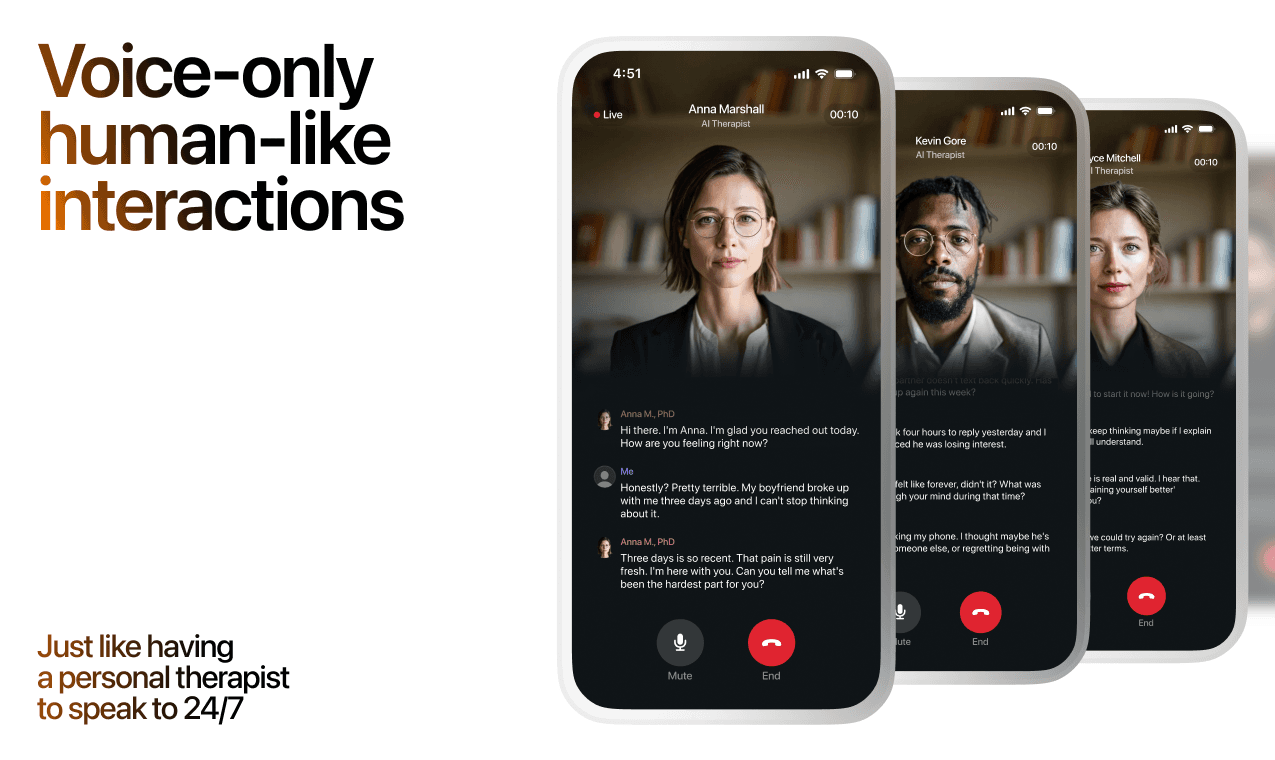
Here's what happens in a typical Lovon session:
You share what's on your mind
There's no script, no intake form, no waiting room. You speak or type whatever you're feeling — in your own words, at your own pace.
Lovon validates and explores
Using frameworks from CBT (Cognitive Behavioral Therapy) and motivational interviewing, Lovon acknowledges your feelings first, then gently helps you explore them. No dismissive "just move on" advice.
You build coping skills together
Lovon doesn't just listen — it actively works with you on evidence-based techniques: thought reframing, urge surfing, behavioral experiments, and more.
What a Session with Lovon Looks Like
When to Seek Professional Help
AI support is a valuable tool, but it's not a replacement for professional care. Please consider reaching out to a licensed therapist if you experience any of the following:
- Persistent thoughts of self-harm or suicide
- Inability to perform daily activities (work, eating, sleeping) for more than 2 weeks
- Turning to alcohol or substances to cope
- Intense anger or desire to harm your ex-partner
- Complete emotional numbness that doesn't improve over time
Crisis Resources (US): If you're in immediate danger, call 988 (Suicide & Crisis Lifeline) or text HOME to 741741 (Crisis Text Line). Available 24/7, free, and confidential.
Outside the US? Find a crisis line in your country
Ready to Start?
Your healing journey can begin right now
A 7-day trial. No judgment. Just a safe space to process what you're going through.
Frequently Asked Questions
Is Lovon a replacement for a real therapist?
Is my conversation with Lovon AI private?
How is Lovon different from ChatGPT for emotional support?
Can I use Lovon if I'm already seeing a therapist?
Can I try Lovon before subscribing?
About the Author
The Lovon Editorial Team
Mental Health & Wellness Content Team
The Lovon Editorial Team develops mental health and wellness content designed to make psychological concepts accessible and actionable. Our goal is to bridge the gap between clinical research and everyday life - helping you understand why your mind works the way it does and what you can do about it....
Related articles
- AI Mental Health App for Veterans With PTSD (2026)
Compare AI mental health apps for veterans with PTSD in 2026: what to look for, top picks, what to avoid, and a clear…
- Best AI Counseling for Stress in 2026
The best AI counseling for stress in 2026: voice-based, on-demand tools ranked by methodology, personalization, and…
- Can AI therapy replace a human therapist?
AI therapy can't replace a licensed human therapist for diagnosis or crisis care in 2026, but it fills the gap between…
- Is it safe to share your feelings with an AI therapist?
Is it safe to share feelings with an AI therapist in 2026? Yes for daily stress and anxiety, not for crisis. See the…
See also
Quizzes
- Loneliness Test: Free 12-Question Self-Check
See which kind of loneliness is thin, in 3 minutes.
- Shame Test: Do You Read Mistakes as Verdicts?
See which exit your shame takes, in 3 minutes.
Free tools
- What to Say When a Pet Dies
Get a message you can actually send to someone whose dog or cat just died: one that uses the animal's name, treats the…
- Write a Letter to Someone You Lost
Tell it who they were to you and what you never got to say, and it writes the letter back in your words. No account, no…
From the wiki
- What does it mean when you dream about your ex?
Dreaming about your ex usually reflects emotional processing, not prophecy and not a message from them. Your sleeping…
Disclaimer: This article is for informational purposes only and does not constitute medical advice, diagnosis, or treatment. Always seek the advice of your physician or other qualified health provider with any questions you may have regarding a medical condition. If you are in crisis or think you may have an emergency, call 988 (Suicide & Crisis Lifeline) or go to the nearest emergency room. Outside the US? Find a crisis line in your country.