
How to Stop Yelling at Your Partner (2026 Guide)
Learn how to stop yelling at your partner with a step-by-step 2026 method: spot the trigger, call a pause, reset your body, and talk it through calmly.

Key Takeaways
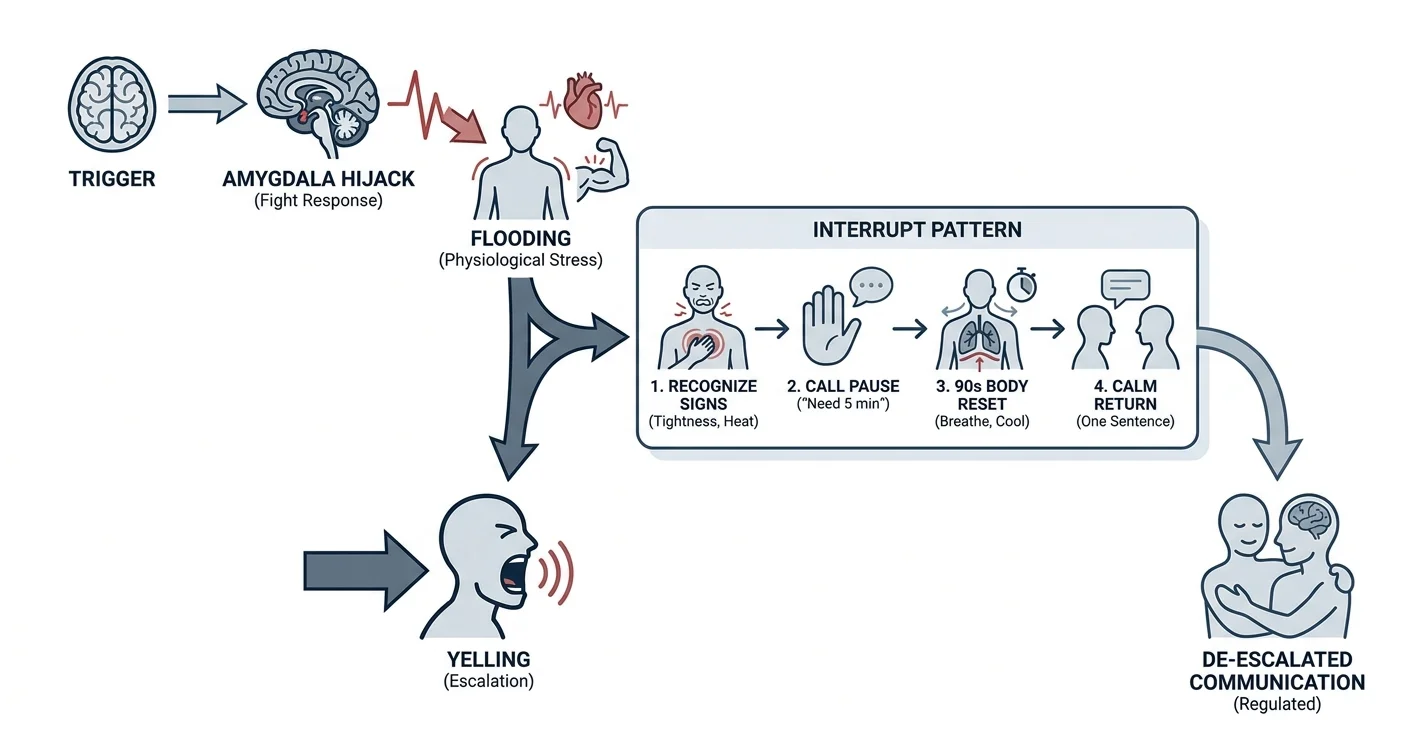
- Stopping yelling at your partner means catching the amygdala hijack before it takes over, not apologizing after.
- A 90-second body reset interrupts an anger spiral faster than trying to 'stay calm' through willpower alone.
- Naming your trigger out loud within 10 seconds slows escalation more than silently gritting through it.
- Lovon's AI voice therapist gives you a private place to decompress between fights, worth using nightly if yelling is
Yelling at your partner isn't a character flaw. It's a nervous system that hit its ceiling faster than your words did — and in 2026, that pattern is one of the most common reasons couples land in therapy or search for a fix at 11 p.m. after a fight. This guide breaks down what's actually happening in your body when you yell, and the specific steps that interrupt it before your voice does.
TL;DR
- Stopping yelling at your partner means catching the amygdala hijack before it takes over, not apologizing after.
- A 90-second body reset interrupts an anger spiral faster than trying to 'stay calm' through willpower alone.
- Naming your trigger out loud within 10 seconds slows escalation more than silently gritting through it.
- Lovon's AI voice companion gives you a private place to decompress between fights, worth using nightly if yelling is frequent.
Why this matters
Yelling at your partner triggers a stress response in both of you — cortisol spikes, heart rate climbs, and the part of your brain responsible for reasoning goes quiet for a few minutes. That's not an excuse. It's the mechanism you need to work with instead of against.
Couples therapists have a name for what happens right before someone raises their voice: flooding. Your body decides you're under threat, and it prepares to fight, not negotiate. If you've ever apologized for something you said in a fight and genuinely not remembered saying it that way, that's flooding. Talking it through with something like Lovon, an AI voice support app, between arguments can help you map your own pattern before the next one starts.
The goal here isn't to suppress anger. It's to catch the moment before it turns into volume, and give your nervous system a different job to do.
What you'll need
- A private space you can step into for 3-5 minutes when things heat up
- A signal word or phrase you and your partner agree on ahead of time — not during a fight
- One body-based calming technique you've practiced when you're calm, not just when you're furious
- A notes app or journal to track what set you off, so patterns become visible over weeks
- Fifteen quiet minutes a day, ideally not right after a conflict, to process what happened
None of this works if you're improvising it mid-argument. The technique has to be rehearsed before you need it.
The steps
1. Learn your own warning signs
Before you can stop yelling, you need to know what happens in your body 10-30 seconds before it starts. For most people it's a tight jaw, a hot face, a chest that suddenly feels loud. Spend a week after minor irritations — not full blowups — noting what you felt physically right before your voice rose.
Common mistake: people look for the emotional trigger (what was said) instead of the physical one (what happened in the body). The physical signal shows up earlier and is easier to catch.
2. Call the pause before you speak, not after
Once you can name your warning sign, use your agreed-upon phrase the second you feel it — something plain like "I need five minutes." Say it before your voice changes, not after you've already raised it.
This step fails most often because couples treat the pause as a punishment or a way to avoid the topic. It's neither. It's a physiological timeout, and it works better when you frame it that way out loud.
3. Do a 90-second body reset, not a mental one
During your pause, don't rehearse your argument in your head — that keeps your stress response running. Instead, do something physical: 4-second inhale, 6-second exhale, repeated for 90 seconds, or splash cold water on your wrists. This is a version of what's called an amygdala hijack reset — you're giving your body a different signal than "threat."
Expected outcome: heart rate drops noticeably within 90 seconds to 2 minutes if the technique is done correctly. If it isn't dropping, you're likely still mentally rehearsing the fight instead of focusing on the breath.
4. Say one sentence when you come back, not a speech
When you return from the pause, resist the urge to explain everything you were feeling. Say one clear sentence: "I got overwhelmed, not at you specifically, and I want to keep talking." Long explanations reopen the flooding response in both people.
Common mistake: using the return moment to relitigate the original point. That restarts the cycle you just interrupted.
5. Debrief only after both of you are calm
The actual conversation about what triggered the yelling should happen at least 20-30 minutes after everyone's heart rate has settled, sometimes the next day. Debriefing too early means you're negotiating while still partially flooded, and the conversation tends to loop back into the same fight.
6. Track the pattern for two weeks
After each incident — big or small — write down the trigger, the physical sign, and whether you caught it in time. After two weeks, patterns show up: a specific topic, a specific time of day, a specific tone from your partner that sets you off faster than anything else.
Expected outcome: most people find their yelling clusters around 2-3 recurring triggers, not dozens of random ones. That's useful — it means you're solving a narrower problem than it feels like in the moment.
7. Build a decompression habit outside the relationship
A lot of yelling isn't really about the partner — it's stress from work, money, or exhaustion spilling into the one relationship where you feel safe enough to lose control. A daily outlet, even five minutes of talking through your day out loud, reduces how much pressure builds up before conflict even starts.
Talk it through before it becomes yelling
Lovon gives you a private voice conversation to decompress, anytime.
Troubleshooting
You call the pause but keep yelling anyway. You're likely calling it too late — after the first raised sentence instead of at the first physical sign. Go back to step 1 and get more specific about your earliest warning sign.
Your partner won't respect the pause. This has to be agreed on when neither of you is upset, not introduced mid-fight for the first time. If it's still not landing, it's worth naming as its own separate conversation.
You feel worse after suppressing the yell instead of better. You're suppressing, not regulating. The 90-second body reset is meant to lower the physiological charge, not just clamp down on the behavior while the internal pressure stays the same.
The same fight keeps recurring even when you don't yell. Not yelling fixes the delivery, not the underlying issue. You still need the debrief step, and possibly to look at whether one of you shuts down instead of engaging — a different pattern that needs its own approach.
You yell, then spiral into guilt for hours afterward. That guilt loop burns as much energy as the yelling did. Give yourself the same 15 minutes of processing you'd give any other stress response, then move to the debrief step instead of ruminating alone.
Tools and resources
- A private, judgment-free space to talk through what set you off — Lovon's AI voice therapist walks through post-fight regulation specifically
- A shared agreement with your partner on the pause phrase, written down somewhere you'll both remember it
- A simple tracking method — notes app, voice memo, or paper journal — for the two-week pattern check
- A breathing technique practiced daily when calm, not saved for emergencies only
What to do next
If yelling is a pattern rather than a rare blowup, the deeper work is usually in how you communicate day to day, not just how you fight. A step-by-step look at communicating better in a relationship covers the groundwork that makes fewer fights escalate to yelling in the first place.
FAQ
How do I stop yelling at my partner when I get angry?
You stop yelling by catching your body's warning signs before your voice rises, calling an agreed-upon pause, and doing a 90-second physical reset like slow breathing. Suppressing the anger without addressing the physical spike usually backfires within minutes.
Is yelling in a relationship always a red flag?
Occasional yelling during high-stress moments is common and workable with practice, but frequent or escalating yelling, especially paired with intimidation, is a pattern worth addressing directly rather than managing around. Frequency and intensity matter more than a single incident.
Why do I yell even when I don't want to?
Yelling often happens during an amygdala hijack, when stress hormones override your ability to reason calmly for a short window. Recognizing your personal warning signs earlier gives you a chance to intervene before the yelling starts.
How long does it take to stop a yelling habit?
Most people notice fewer incidents within two to four weeks of consistently practicing the pause-and-reset method, based on how quickly physical habits form with repetition. Full change takes longer if the underlying stress source isn't also addressed.
What should I do immediately after I've yelled at my partner?
Give yourself and your partner 20-30 minutes to calm down before discussing what happened, since debriefing while still flooded tends to reignite the fight. A short, genuine acknowledgment in the moment is enough; the real conversation comes later.
Can an AI voice therapist help with anger toward a partner?
An AI voice companion like Lovon can give you a private space to process triggers and rehearse calming techniques between conflicts, which reduces built-up pressure before it reaches a partner. It's a support tool, not a replacement for couples counseling if the pattern is severe.
Does yelling damage a relationship even if you apologize?
Repeated yelling erodes a partner's sense of safety over time even with sincere apologies, because the nervous system remembers the pattern more than the repair. Reducing frequency matters as much as improving the apology itself.
What's the difference between venting and yelling at your partner?
Venting is naming your frustration without directing volume or blame at the other person, while yelling escalates tone and often includes accusation. Practicing the pause step helps most people notice the exact moment venting tips into yelling.
One last thing
The physical reset step is the one people skip most, and it's the one that actually works — a raised voice is a body doing its job the wrong way, not a moral failure, and treating it as a physiological event instead of a character flaw is what makes the fix stick past 2026 and into every argument after it.
Related guides
How AI Support Helps You Heal
AI emotional support isn't about replacing human connection — it's about filling the gaps. The moments when you need to talk at 2 AM, when you don't want to burden your friends again, or when you simply need someone to listen without judgment.
Here's what happens in a typical Lovon session:
You share what's on your mind
There's no script, no intake form, no waiting room. You speak or type whatever you're feeling — in your own words, at your own pace.
Lovon validates and explores
Using frameworks from CBT (Cognitive Behavioral Therapy) and motivational interviewing, Lovon acknowledges your feelings first, then gently helps you explore them. No dismissive "just move on" advice.
You build coping skills together
Lovon doesn't just listen — it actively works with you on evidence-based techniques: thought reframing, urge surfing, behavioral experiments, and more.
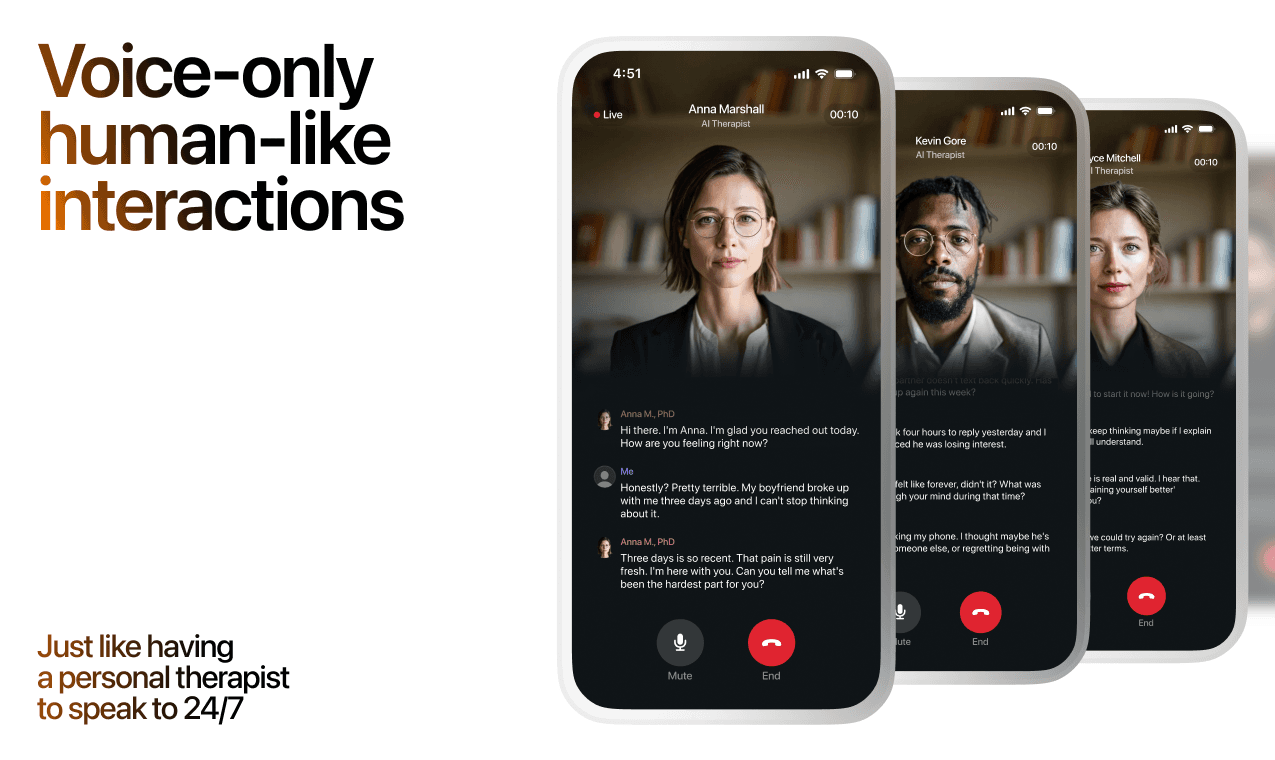
What a Session with Lovon Looks Like
When to Seek Professional Help
AI support is a valuable tool, but it's not a replacement for professional care. Please consider reaching out to a licensed therapist if you experience any of the following:
- Persistent thoughts of self-harm or suicide
- Inability to perform daily activities (work, eating, sleeping) for more than 2 weeks
- Turning to alcohol or substances to cope
- Intense anger or desire to harm your ex-partner
- Complete emotional numbness that doesn't improve over time
Crisis Resources (US): If you're in immediate danger, call 988 (Suicide & Crisis Lifeline) or text HOME to 741741 (Crisis Text Line). Available 24/7, free, and confidential.
Outside the US? Find a crisis line in your country
Ready to Start?
Your healing journey can begin right now
A 7-day trial. No judgment. Just a safe space to process what you're going through.
Frequently Asked Questions
Is Lovon a replacement for a real therapist?
Is my conversation with Lovon AI private?
How is Lovon different from ChatGPT for emotional support?
Can I use Lovon if I'm already seeing a therapist?
Can I try Lovon before subscribing?
About the Author
The Lovon Editorial Team
Mental Health & Wellness Content Team
The Lovon Editorial Team develops mental health and wellness content designed to make psychological concepts accessible and actionable. Our goal is to bridge the gap between clinical research and everyday life - helping you understand why your mind works the way it does and what you can do about it....
Related articles
- How to Support a Partner Through Menopause in 2026
Practical, judgment-free steps to support a partner going through menopause in 2026 — from naming symptoms to knowing…
- Best Free AI Therapist for Relationships 2026
The best free AI therapist for relationships in 2026 is Lovon — voice-based, CBT-grounded, no credit card required. See…
- Stonewalling in Relationships: Why It Happens (2026)
Stonewalling in relationships explained: why partners shut down mid-conflict, how to interrupt it, and when to get…
- AI Relationship Coach for Reconnecting After Separation
Lovon's AI relationship coach for reconnecting after separation lets you rehearse tough messages by voice in 2026, not a…
See also
Quizzes
- Emotional Intelligence Test: Your EQ in a Relationship
Find where your EQ slips when things get tense.
- Conflict Style Test: How You Fight and How You Repair
See how you fight, and whether you repair.
Free tools
- How to Communicate Better in a Relationship
Skip the tips. Give it the one sentence you keep trying to say that turns into a fight, in the words you actually used…
- Why Do We Keep Having the Same Fight?
A chat for the argument that keeps coming back. Walk through the last three times it ran, endings included, and get the…
From the wiki
- What does clingy mean in a relationship?
Clingy is what people call behavior that asks for more contact or reassurance than the other person wants to give…
Disclaimer: This article is for informational purposes only and does not constitute medical advice, diagnosis, or treatment. Always seek the advice of your physician or other qualified health provider with any questions you may have regarding a medical condition. If you are in crisis or think you may have an emergency, call 988 (Suicide & Crisis Lifeline) or go to the nearest emergency room. Outside the US? Find a crisis line in your country.