
AI Relationship Coach for Open Relationships (2026)
Lovon's AI relationship coach for open relationships handles jealousy check-ins and boundary rehearsal in 2026 — see where it helps and where it can't.
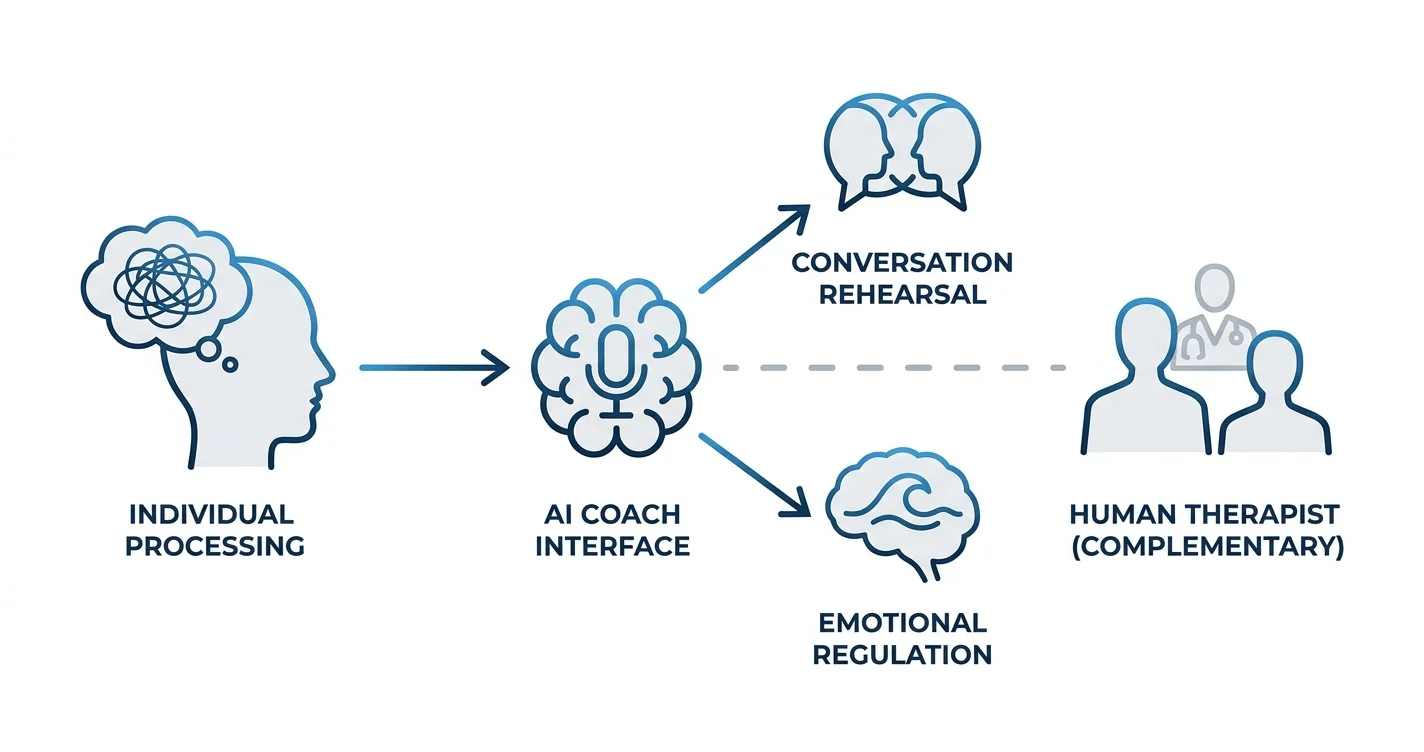

Key Takeaways
- Lovon works as an AI relationship coach for open relationships when you need a same-night place to process jealousy
- It's not built to mediate live between partners or settle whether your relationship structure is 'working' — use it
- Best fit: solo check-ins after a hard talk, pre-conversation rehearsal, and journaling-style debriefs after a date
- Skip it as your only support if you're navigating active infidelity discovery, abuse dynamics, or a structure
An AI relationship coach for open relationships gives you a place to process jealousy, rehearse hard conversations, and check your own reactions between talks with a partner or metamour — without waiting for a therapy slot that may not even specialize in non-monogamy.
TL;DR
- Lovon works as an AI relationship coach for open relationships when you need a same-night place to process jealousy or rehearse a boundary conversation.
- It's not built to mediate live between partners or settle whether your relationship structure is 'working' — use it for individual processing, not group decisions.
- Best fit: solo check-ins after a hard talk, pre-conversation rehearsal, and journaling-style debriefs after a date night or disclosure.
- Skip it as your only support if you're navigating active infidelity discovery, abuse dynamics, or a structure decision that needs a specialized therapist.
Why this matters
Most mental health apps are built around monogamous defaults. Anxiety modules, relationship quizzes, attachment content — almost none of it accounts for the specific emotional load of managing multiple partners, negotiating new agreements, or sitting with jealousy that isn't a sign anything is wrong.
That gap is exactly where an AI relationship coach earns its place in 2026: not as a replacement for a poly-informed therapist, but as the thing you talk to at 11pm when a wave of jealousy hits and no one else is awake. Lovon is built around voice conversations you can start in seconds, which matters more in non-monogamy than most relationship contexts — the moments that need processing rarely happen on a schedule.
Who this is for
This guide is for people already in, or actively negotiating, an open relationship, polyamorous structure, or ethically non-monogamous arrangement — not people looking for permission or a verdict on whether to open up. If you're managing new relationship energy, compersion that isn't showing up yet, a metamour dynamic that feels tense, or a boundary conversation you keep avoiding, an AI relationship coach fills the gaps between check-ins with a partner or a human therapist.
What to look for in an AI relationship coach for open relationships
It doesn't default to monogamous assumptions
A coach that reflexively frames jealousy as a red flag or nudges you toward "just pick one person" isn't useful here. What you need is a tool that can sit with jealousy as data — something to name and unpack — rather than a problem to solve by narrowing your relationship structure.
It's available when the spiral starts, not during business hours
Jealousy and anxiety in non-monogamy rarely wait for a scheduled session. A tool you can talk to at 2am after a partner's date runs long matters more than one with a polished dashboard you check once a week.
It helps you rehearse, not just vent
Venting feels good for five minutes and changes nothing. What actually moves a hard conversation forward is saying the words out loud first — practicing how you'll bring up a boundary or a scheduling conflict before you bring it to your partner or metamour.
It's honest about what it can't do
Any AI tool that implies it can mediate a three-way conversation, resolve a metamour conflict, or tell you whether your relationship structure is healthy is overselling itself. The honest version says plainly: I can help you process and prepare, not decide for you.
It keeps your boundaries intact between sessions
Open relationships run on explicit agreements — check-in cadence, disclosure rules, safer-sex terms. A coach worth using should help you get clearer on your own boundaries, not blur them by offering generic relationship advice that assumes a closed dyad.
It works alongside a human therapist, not instead of one
If you're seeing a poly-informed therapist or counselor, the AI coach should complement that work — a place for the small daily processing, not a substitute for a professional handling something clinical, like unprocessed trauma or a structure decision with real stakes.
Where an AI relationship coach for open relationships actually helps
The jealousy check-in. You feel a spike after a partner mentions a great date with someone else. A 10-15 minute voice session to name what's underneath the feeling — scarcity, comparison, an old attachment wound — beats sitting with it alone for hours. Use it.
The boundary rehearsal. You need to bring up a new limit around overnight stays or disclosure timing and you've rewritten the text four times. Saying it out loud to an AI coach first, then adjusting the wording, gets you to the actual conversation faster. Lovon's healthy relationship boundaries framing is useful groundwork before you rehearse. Use it.
The post-disclosure decompression. A partner just told you about a new connection and you need somewhere to process before you respond. A same-night session keeps you from reacting from the raw version of the feeling. Use it.
The trust-repair session after a broken agreement. Someone missed a check-in or crossed a line and you're deciding how much of your reaction is proportionate. This is where Lovon's trust-issues coaching is relevant — it's built for exactly this kind of post-rupture sorting, not for deciding whether the relationship is over. Consider it — useful for your own processing, not for the actual repair conversation.
The "is this even a problem" gut-check. You're spending too much time trying to decide if a dynamic with a metamour is enmeshment, jealousy, or a legitimate boundary issue. A coach can help you separate the threads, though a tangled dynamic like enmeshment sometimes needs more than a single session to untangle. Consider it.
What to avoid
- Using it as a mediator. An AI voice tool talking to one person at a time can't referee a live three-way disagreement — that needs a human in the room, or a poly-informed couples counselor.
- Treating a "relationship break" decision as something the AI can settle. Deciding whether to take a break in the relationship is a decision for you and your partners, informed by the coach's help processing your own feelings — not a verdict the tool hands down.
- Skipping professional care for anything clinical. Active infidelity discovery, abuse dynamics, or trauma responses need a licensed clinician. Lovon is explicit that it supports, it doesn't replace, licensed care.
Talk it through tonight
Start a voice session when jealousy or a hard conversation hits, no appointment needed.
Verdict comparison across common scenarios
| Scenario | What you need | Fit for an AI coach in 2026 | Verdict |
|---|---|---|---|
| Jealousy spike after a partner's date | Same-night processing | Strong — available anytime | Use it |
| Rehearsing a boundary conversation | Practice saying it out loud | Strong — low-stakes rehearsal space | Use it |
| Metamour conflict needing mediation | A third party in the room | Weak — no live mediation | Skip it |
| Deciding whether to open the relationship | Structural decision support | Weak — not a decision-maker | Skip it |
| Processing after a broken agreement | Individual reflection before the real talk | Moderate — helps you, not the repair itself | Consider it |
FAQ
What is an AI relationship coach for open relationships?
It's a voice or chat-based AI tool that helps you process jealousy, rehearse hard conversations, and reflect on your own reactions in a non-monogamous relationship. It supports individual processing between talks with partners or a therapist — it doesn't mediate group conversations or make structural decisions for you.
Can an AI coach replace a poly-informed therapist?
No. An AI relationship coach like Lovon is built for on-demand emotional support and coping tools, not licensed clinical care. For unprocessed trauma, abuse dynamics, or complex structural decisions, a human therapist with non-monogamy experience is the right call.
Is Lovon good for processing jealousy in polyamory?
Yes, for individual processing. A same-night voice session to name what's underneath a jealousy spike is one of the strongest use cases for an AI relationship coach in 2026, since jealousy rarely waits for a scheduled appointment.
Can AI mediate a conversation between me and my metamour?
No. Voice AI tools talk to one person at a time, so they can't referee a live three-way conversation. Use the coach to prepare what you want to say, then bring it to the actual conversation yourself.
How much does an AI relationship coach cost compared to therapy?
Costs vary by app and plan, but AI coaching tools are generally priced far below traditional therapy, which can run $100-$250 per session without insurance in 2026. Check current pricing directly on the app before comparing.
Is it normal to feel jealous in an open relationship?
Yes. Jealousy in non-monogamy is common and isn't automatically a sign the relationship structure is wrong. The useful question isn't whether you feel it, but what it's telling you about a need, a boundary, or an old attachment pattern worth naming.
What should I avoid asking an AI relationship coach?
Avoid asking it to decide whether your relationship should stay open, whether to leave a partner, or to resolve a conflict on someone else's behalf. Those are decisions for you and the people involved, not a verdict from an AI tool.
One last thing
The part people skip: the best use of an AI relationship coach in open relationships isn't the big blowups, it's the five-minute check-ins after ordinary moments — a partner texting "running late from their date" — where naming the small feeling before it compounds keeps the bigger conversation from happening at 1am and going sideways.
Related guides
How AI Support Helps You Heal
AI emotional support isn't about replacing human connection — it's about filling the gaps. The moments when you need to talk at 2 AM, when you don't want to burden your friends again, or when you simply need someone to listen without judgment.
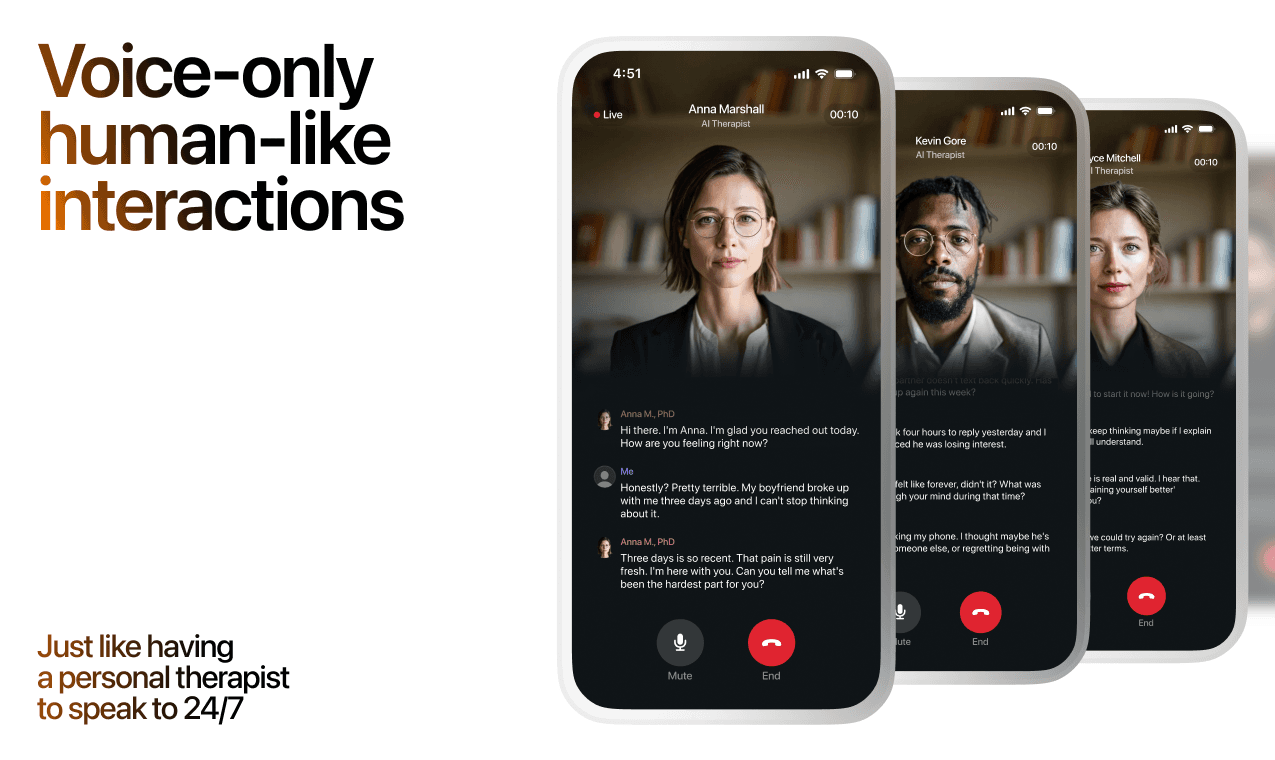
Here's what happens in a typical Lovon session:
You share what's on your mind
There's no script, no intake form, no waiting room. You speak or type whatever you're feeling — in your own words, at your own pace.
Lovon validates and explores
Using frameworks from CBT (Cognitive Behavioral Therapy) and motivational interviewing, Lovon acknowledges your feelings first, then gently helps you explore them. No dismissive "just move on" advice.
You build coping skills together
Lovon doesn't just listen — it actively works with you on evidence-based techniques: thought reframing, urge surfing, behavioral experiments, and more.
What a Session with Lovon Looks Like
When to Seek Professional Help
AI support is a valuable tool, but it's not a replacement for professional care. Please consider reaching out to a licensed therapist if you experience any of the following:
- Persistent thoughts of self-harm or suicide
- Inability to perform daily activities (work, eating, sleeping) for more than 2 weeks
- Turning to alcohol or substances to cope
- Intense anger or desire to harm your ex-partner
- Complete emotional numbness that doesn't improve over time
Crisis Resources (US): If you're in immediate danger, call 988 (Suicide & Crisis Lifeline) or text HOME to 741741 (Crisis Text Line). Available 24/7, free, and confidential.
Outside the US? Find a crisis line in your country
Ready to Start?
Your healing journey can begin right now
A 7-day trial. No judgment. Just a safe space to process what you're going through.
Frequently Asked Questions
Is Lovon a replacement for a real therapist?
Is my conversation with Lovon AI private?
How is Lovon different from ChatGPT for emotional support?
Can I use Lovon if I'm already seeing a therapist?
Can I try Lovon before subscribing?
About the Author
The Lovon Editorial Team
Mental Health & Wellness Content Team
The Lovon Editorial Team develops mental health and wellness content designed to make psychological concepts accessible and actionable. Our goal is to bridge the gap between clinical research and everyday life - helping you understand why your mind works the way it does and what you can do about it....
Related articles
- AI Relationship Coach for Newlyweds: 2026 Verdict
The best ai relationship coach for newlyweds in 2026 is voice-based and available on demand. See picks, what to avoid…
- Best AI Relationship Coach for Anxious Attachment 2026
Find the best AI relationship coach for anxious attachment in 2026. Lovon offers voice-based, on-demand emotional…
- AI Relationship Coach for Dating App Burnout: Buy in 2026
Wiped out from swiping? See how an AI relationship coach for dating app burnout helps in 2026, what to look for, and…
- AI Relationship Coach for Dating After Divorce: Buy 2026
See what an AI relationship coach for dating after divorce should offer in 2026, where Lovon fits, and what to skip…
See also
Quizzes
- Conflict Style Test: How You Fight and How You Repair
See how you fight, and whether you repair.
- Am I Sabotaging My Relationship? 12-Question Quiz
Find the move you reach for, in 2 minutes.
Free tools
- Conversation Starters for Couples, Picked for Tonight
Most lists hand you a hundred questions and no idea which one to open with. Say how long you have been together, what…
- Deep Conversation Starters That Fit the Person You're Asking
The right question depends on who is across from you and how much history is behind it. Tell it who you are talking to…
From the wiki
- Is he in love with me?
There is no reliable tell in how fast he texts or how intense things feel. What tracks with love is consistency…
Disclaimer: This article is for informational purposes only and does not constitute medical advice, diagnosis, or treatment. Always seek the advice of your physician or other qualified health provider with any questions you may have regarding a medical condition. If you are in crisis or think you may have an emergency, call 988 (Suicide & Crisis Lifeline) or go to the nearest emergency room. Outside the US? Find a crisis line in your country.