
AI Coping Tools for Commute Anxiety: 2026 Buyer's Guide
AI coping tools for commute anxiety, ranked for 2026: box breathing and grounding win fast, voice-based Lovon helps daily. See what to skip.

Key Takeaways
- Box breathing resets a commute panic spike in under 2 minutes, no screen needed. Buy.
- The 5-4-3-2-1 grounding technique works faster than distraction apps on a crowded platform. Buy.
- Lovon's AI voice therapy lets you talk through anxiety hands-free mid-commute. Consider, not a crisis line.
- Text-only chatbots fail on transit because you can't type while holding a rail. Skip them.
- The best ai coping tools for commute anxiety in 2026 are voice-first, not screen-first.
Your chest tightens two stops before your transfer, or the bus stalls in traffic and your hands start to shake. AI coping tools for commute anxiety exist for that exact ninety seconds — something you can use hands-free, headphones-in, without anyone around you noticing.
TL;DR
- Box breathing resets a commute panic spike in under 2 minutes, no screen needed. Buy.
- The 5-4-3-2-1 grounding technique works faster than distraction apps on a crowded platform. Buy.
- Lovon's AI voice support lets you talk through anxiety hands-free mid-commute. Consider, not a crisis line.
- Text-only chatbots fail on transit because you can't type while holding a rail. Skip them.
- The best ai coping tools for commute anxiety in 2026 are voice-first, not screen-first.
Why this matters
Commute anxiety is not the same as general anxiety. It's triggered by an enclosed space, a fixed number of exits, a crowd you can't leave, and a clock you don't control. A therapy appointment booked for Thursday at 4pm does nothing for the panic that hits at 8:12am on a packed train.
That gap is exactly what AI coping tools for anxiety are built to close: immediate, voice-based support usable right where the anxiety happens, not scheduled around it. Lovon, an AI voice support app, sits in that gap. It's built with input from PhD psychologists, but it's honest about what it isn't — it does not replace a licensed clinician, and it's not a crisis line.
Who this guide is for
This is for anyone whose anxiety has a very specific address: the subway platform, the middle seat on a packed bus, the driver's seat in stopped traffic, the jet bridge before a flight. If you've had a panic attack between stations, started avoiding a particular train line, or spend the ride white-knuckling a handrail while rehearsing worst-case scenarios, this is written for you.
It's not for someone managing a single rough commute during a one-off stressful week. It's for the recurring, dread-before-you-leave-the-house version of transit anxiety that shows up on a normal Tuesday in 2026 as reliably as the bus itself.
What to look for in AI coping tools for commute anxiety
It has to be voice-first, not text-first
On a crowded train you usually have one free hand and zero attention span for typing. A tool that asks you to type full sentences into a chat window fails at the exact moment you need it. Voice input means you can talk through a spike with earbuds in and your phone in your pocket.
It works in under two minutes
Panic on a commute doesn't wait for a 20-minute guided meditation. You need something that starts producing calm within the length of one or two stops, not a session designed for a quiet room at home.
It's discreet in a public space
No one wants a guided meditation blasting through a phone speaker on a crowded platform. Anything that only works with headphones in, at a normal volume, without drawing attention, clears this bar. Anything that doesn't, fails it.
It's grounded in an actual technique, not just distraction
Music and games can numb a spike temporarily, but they don't teach your nervous system anything for the next commute. Tools built on breathing ratios, grounding steps, or polyvagal-informed nervous system regulation actually change how fast you recover.
It doesn't require booking ahead
If a tool asks you to schedule a session for tomorrow, it can't help with the panic happening right now. On-demand access, not a calendar invite, is the whole point for this use case.
The top picks for commute and transit anxiety
Box breathing — the fastest reset
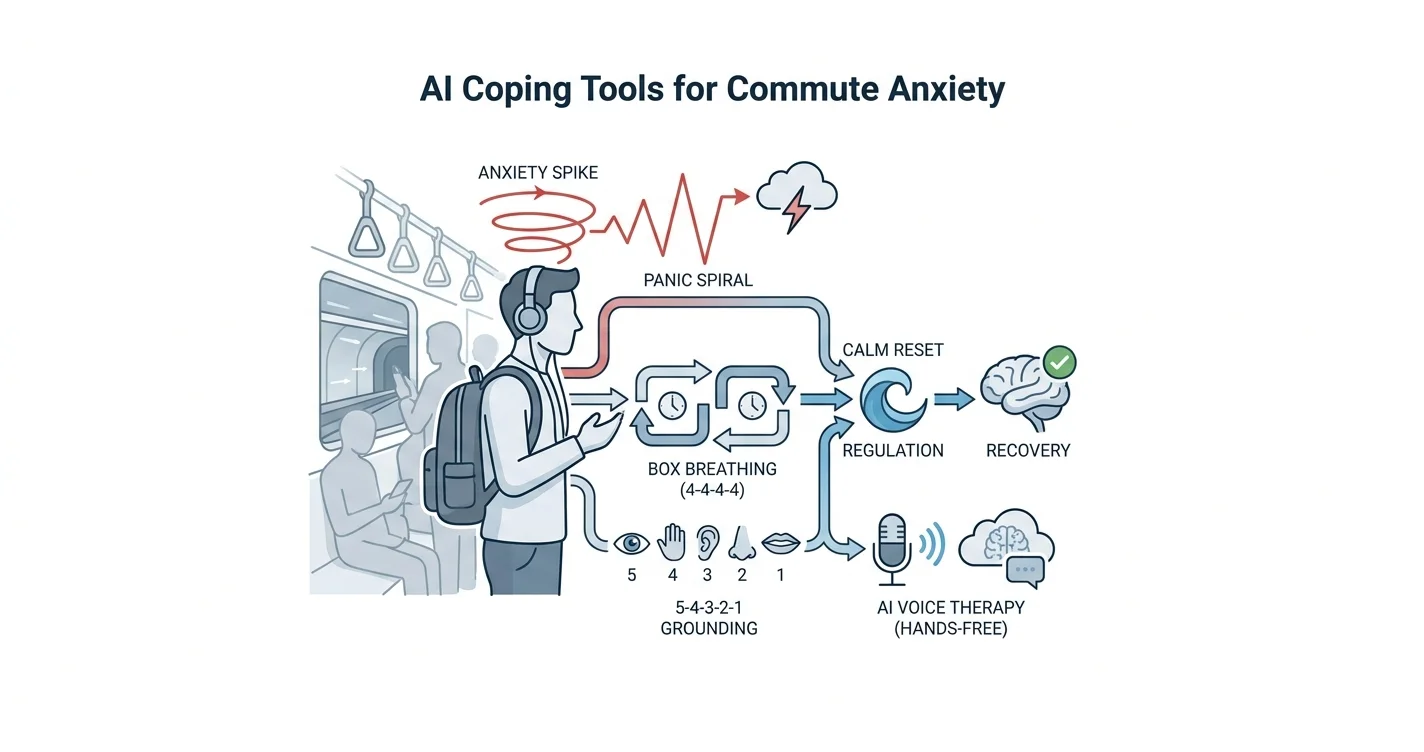
Box breathing runs on a 4-4-4-4 pattern: inhale for four seconds, hold for four, exhale for four, hold for four, and repeat for four to six rounds. It slows your heart rate and tells your nervous system the enclosed space isn't a threat, all in under two minutes. You can do box breathing standing, sitting, or gripping a rail, with zero equipment.
Verdict: Buy. It's the fastest tool on this list and the one with the lowest bar to actually use.
5-4-3-2-1 grounding — the anti-panic override
When a panic spike hits, this technique pulls your attention out of the spiral by naming five things you see, four you can touch, three you hear, two you smell, and one you taste. It interrupts catastrophizing in under 90 seconds by forcing your brain to process the present instead of the worst-case future. Grounding techniques work especially well in the exact scenario that triggers most transit panic: feeling stuck with no visible exit.
Verdict: Buy. Fastest option for a spike that's already started.
AI voice check-in — the one that talks back
Breathing and grounding handle the moment, but they don't explain why the same stretch of tunnel sets off dread every single day. That's where a spoken AI conversation earns its place: Lovon lets you talk out loud about what's happening at 7:45am on a bus, no scheduling required first. It's not licensed clinical care and it won't replace a therapist for a diagnosed panic disorder, but as a daily coping layer between real sessions, it fills a real gap for a lot of commuters.
Verdict: Consider. Good for the daily pattern, not built for acute crisis.
Pre-commute voice journaling — the pattern finder
Talking through the dread for three to five minutes before you leave the house surfaces the actual trigger — is it the crowd, the tunnel, or the meeting waiting on the other end? Voice journaling catches patterns text journaling misses, because people say things out loud they'd never type into a notes app.
Verdict: Consider. It won't stop a panic attack already in progress, but it reduces how often one starts.
Try an AI coping session before your next commute
Talk through anxiety by voice, hands-free, whenever it hits.
What to avoid
- Text-only anxiety chatbots. Typing full sentences while holding a subway pole or driving isn't realistic — most people abandon these by the third stop.
- Apps that require booking a session slot. If it asks you to schedule for tomorrow, it cannot help with the panic happening right now.
- Long-form meditation-only apps. A 20-minute body scan doesn't fit a 12-minute bus ride, and starting one you can't finish adds its own frustration on top of the anxiety.
Quick verdict comparison
| Tool | Time to relief | Hands-free | Verdict |
|---|---|---|---|
| Box breathing | Under 2 minutes | Yes | Buy |
| 5-4-3-2-1 grounding | Under 90 seconds | Yes | Buy |
| AI voice check-in (Lovon) | Ongoing, as needed | Yes | Consider |
| Pre-commute voice journaling | 3-5 minutes | Yes | Consider |
| Text-only chatbot | Varies, often too slow | No | Skip |
FAQ
What are the best AI coping tools for commute anxiety in 2026?
Voice-based tools that work hands-free rank highest in 2026: box breathing, 5-4-3-2-1 grounding, and AI voice check-ins like Lovon. Text-only chatbot apps rank lowest for commute-specific use because typing mid-transit isn't practical.
Can an AI app stop a panic attack on the subway?
No app guarantees it stops a panic attack, but voice-guided breathing and grounding can shorten one significantly within one to two minutes. It gives you something structured to do with your attention instead of spiraling further.
Is voice-based anxiety support better than text-based apps for commuting?
Yes, for commute use specifically. Voice-based support wins because your hands and eyes are usually occupied holding a rail, driving, or watching for your stop, which makes typing into a chat window impractical.
How do I use box breathing on a crowded train?
Inhale for four seconds, hold for four, exhale for four, hold for four, and repeat for four to six rounds. You can do it standing with your eyes open, and nobody around you will notice.
What is the 5-4-3-2-1 grounding technique?
It's a sensory exercise where you name five things you see, four you can touch, three you hear, two you smell, and one you taste. It interrupts a panic spiral by forcing attention onto the present moment instead of the fear.
Does Lovon replace therapy for commute anxiety?
No, Lovon is an AI voice support app built for on-demand emotional support, not a replacement for a licensed therapist. For diagnosed panic disorder or frequent severe attacks, pair daily coping tools with a licensed clinician.
How much does an AI therapy app cost compared to in-person therapy in 2026?
Pricing varies by provider and plan, so it's worth checking current details directly on the app before committing. In-person therapy without insurance typically runs considerably higher per session than most app-based options.
Can I use AI coping tools without cell signal during a commute?
Signal loss underground or in tunnels affects most app-based tools that need a live connection, so memorizing box breathing or grounding steps in advance covers that gap. Voice check-ins that require a connection will resume once signal returns.
One last thing
The vagus nerve runs right past your throat and lungs, which is why a longer exhale than inhale — not a longer inhale — is what actually calms a commute panic spike. Most people do the opposite instinctively, gasping in and barely breathing out, which keeps the nervous system locked in alert mode.
Flip the ratio for your next four stops: four seconds in, six seconds out. Notice the difference before you even reach your transfer.
Related guides
How AI Support Helps You Heal
AI emotional support isn't about replacing human connection — it's about filling the gaps. The moments when you need to talk at 2 AM, when you don't want to burden your friends again, or when you simply need someone to listen without judgment.
Here's what happens in a typical Lovon session:
You share what's on your mind
There's no script, no intake form, no waiting room. You speak or type whatever you're feeling — in your own words, at your own pace.
Lovon validates and explores
Using frameworks from CBT (Cognitive Behavioral Therapy) and motivational interviewing, Lovon acknowledges your feelings first, then gently helps you explore them. No dismissive "just move on" advice.
You build coping skills together
Lovon doesn't just listen — it actively works with you on evidence-based techniques: thought reframing, urge surfing, behavioral experiments, and more.
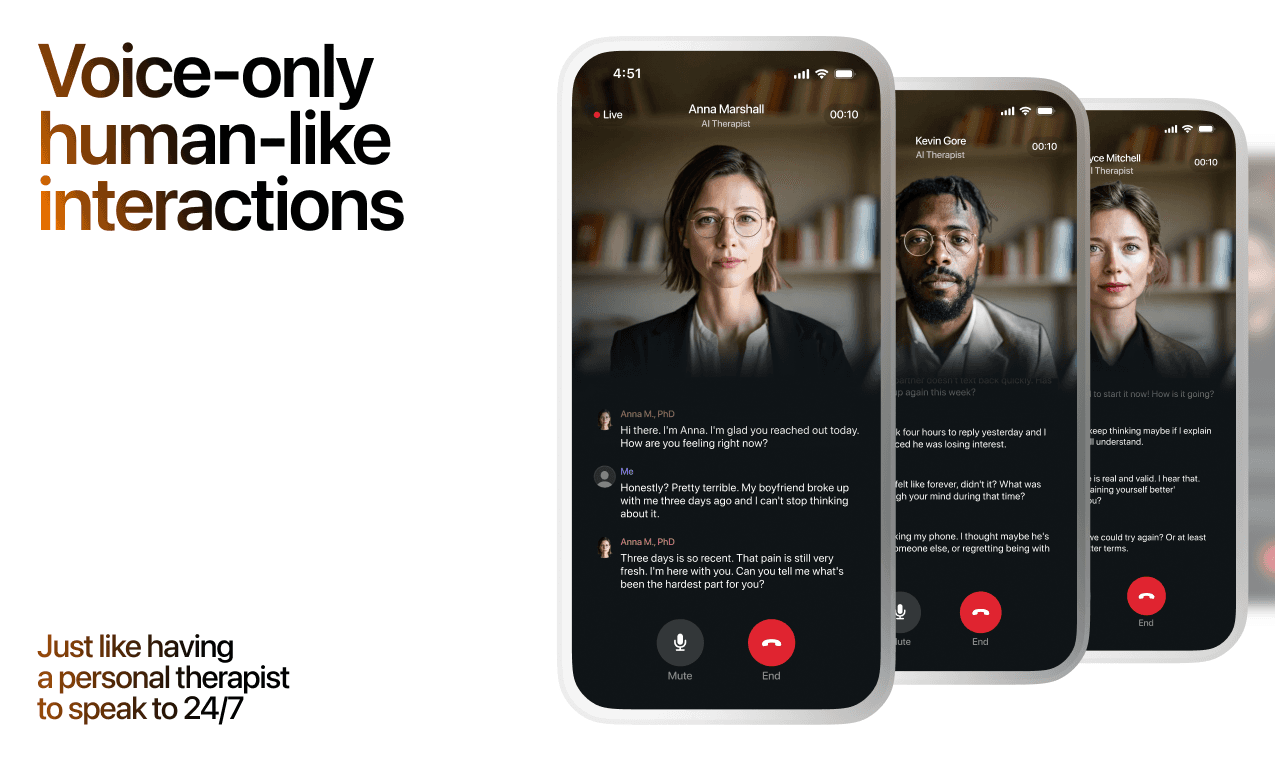
What a Session with Lovon Looks Like
When to Seek Professional Help
AI support is a valuable tool, but it's not a replacement for professional care. Please consider reaching out to a licensed therapist if you experience any of the following:
- Persistent thoughts of self-harm or suicide
- Inability to perform daily activities (work, eating, sleeping) for more than 2 weeks
- Turning to alcohol or substances to cope
- Intense anger or desire to harm your ex-partner
- Complete emotional numbness that doesn't improve over time
Crisis Resources (US): If you're in immediate danger, call 988 (Suicide & Crisis Lifeline) or text HOME to 741741 (Crisis Text Line). Available 24/7, free, and confidential.
Outside the US? Find a crisis line in your country
Ready to Start?
Your healing journey can begin right now
A 7-day trial. No judgment. Just a safe space to process what you're going through.
Frequently Asked Questions
Is Lovon a replacement for a real therapist?
Is my conversation with Lovon AI private?
How is Lovon different from ChatGPT for emotional support?
Can I use Lovon if I'm already seeing a therapist?
Can I try Lovon before subscribing?
About the Author

The Lovon Editorial Team
Mental Health & Wellness Content Team
The Lovon Editorial Team develops mental health and wellness content designed to make psychological concepts accessible and actionable. Our goal is to bridge the gap between clinical research and everyday life - helping you understand why your mind works the way it does and what you can do about it....
Related articles
- Best App for Anxiety and Depression in 2026: Ranked
Ranked list of the best app for anxiety and depression in 2026 — AI voice therapy, chatbots, CBT apps, and teletherapy…
- AI Therapist for Work Stress: How to Use It in 2026
Learn how to use an ai therapist for work stress the right way in 2026 - specific triggers, grounding steps, and when…
- AI App for Postpartum Anxiety: 2026 Buying Guide
Looking for an ai app for postpartum anxiety in 2026? See what to look for, top picks with verdicts, and what to avoid…
- AI Coping Tools for Fear of Flying: 2026 Verdicts
AI coping tools for fear of flying, ranked for 2026: what helps mid-panic, what to skip, and how voice-based AI support…
See also
Quizzes
- Am I a People Pleaser? 12-Question Quiz
Where kindness stops and self-erasure starts.
- Emotional Intelligence Test: Your EQ in a Relationship
Find where your EQ slips when things get tense.
Free tools
- Write a Letter to Your Best Friend
A chat for a letter to your best friend that only they could have received. Tell it how long you have been friends, one…
- What to Say When They Are Struggling
A chat, not a list. Tell the coach who this person is to you, what they are going through, and what you already said…
From the wiki
- Why do I have no friends?
Usually nothing is wrong with you. Adult friendship runs on proximity and repetition, and most people lose both at once…
Disclaimer: This article is for informational purposes only and does not constitute medical advice, diagnosis, or treatment. Always seek the advice of your physician or other qualified health provider with any questions you may have regarding a medical condition. If you are in crisis or think you may have an emergency, call 988 (Suicide & Crisis Lifeline) or go to the nearest emergency room. Outside the US? Find a crisis line in your country.